

Those who purchase industrial gas equipment are very likely to have encountered the problem of “confusing cryogenic storage tanks with ordinary pressure vessels”. I once helped a local food quick-freezing factory with an air supply plan, and witnessed firsthand how they took the easy way out by converting an ordinary pressure vessel into a cryogenic storage tank. However, after only three months of operation, the interlayer vacuum immediately failed, and the liquid nitrogen evaporated at a rate of half a ton per day. Finally, they spent over ten thousand yuan on rework to solve the problem. In fact, these two types of equipment are fundamentally different. From the design concept to daily operation and maintenance, every detail difference directly affects production safety and long-term usage costs.
They took completely different design paths from the very beginning
The core logic of ordinary pressure vessels is simply “withstand pressure”. From the drawing stage, it focuses on the pressure-bearing capacity under normal temperature conditions. As long as it can withstand a working pressure of 0.1 MPa or more without cracking or leaking, it has fulfilled the core goal. Many conventional air storage tanks and reaction tanks that I have come across can be made using ordinary Q235 carbon steel sheet welding. During the design process, there is no need to consider material changes due to temperature. As long as the wall thickness is calculated according to the GB150 standard and a hydrostatic test is passed, it can be delivered.
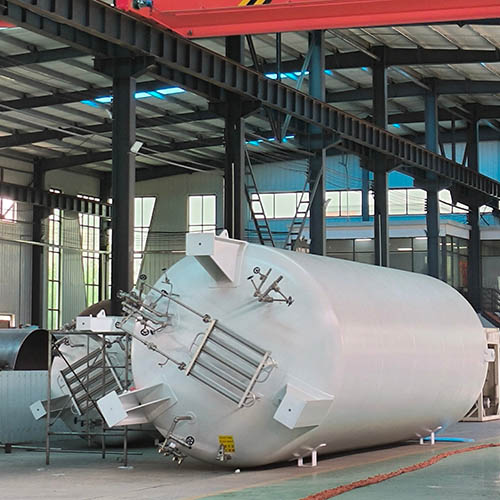
On the other hand, the design origin of cryogenic storage tanks is “withstand ultra-low temperatures while preserving cold energy”. It is essentially a professional industrial large freezer with pressure-bearing capacity. To firmly lock -196℃ liquid oxygen and nitrogen in the tank and prevent any trace of heat from entering from the outside. Even though its working pressure is only 1.6 MPa, much lower than many high-pressure pressure vessels, it cannot be done using the thinking of ordinary pressure vessels. This is the first major pit that many beginners are prone to fall into.
The details of structure and materials differ greatly
I am familiar with equipment manufacturing factories and have seen the production sites of ordinary pressure vessels. I have also been in the assembly workshop of cryogenic storage tanks. The workmanship precision of the two is completely on a different level.
Ordinary pressure vessels are mostly single-layer tanks, and the thickness of the sheet is calculated based on the pressure-bearing capacity. After welding, a simple non-destructive testing is done, and a layer of anti-corrosion paint is applied to be delivered, with only a thin layer of rock wool for surface condensation prevention in summer.
Cryogenic storage tanks are much more meticulous. They must be made with an inner and outer two-layer tank: the inner layer must use 304L or aluminum alloy materials that do not become brittle at minus two hundred degrees Celsius, even if it costs several times more, it cannot be saved. Otherwise, the steel plate will directly break like glass under low temperature. The interlayer of the two-layer tank must be evacuated to a high vacuum of 10⁻³ Pa or more, and filled with pearlite sand or multi-layer insulation films to block all three heat transfer paths of conduction, convection, and radiation. I have measured a qualified 100-cubic cryogenic tank, and after being filled with liquid nitrogen, the daily evaporation loss was less than 0.3%. This cold preservation effect is unimaginable for ordinary pressure vessels.
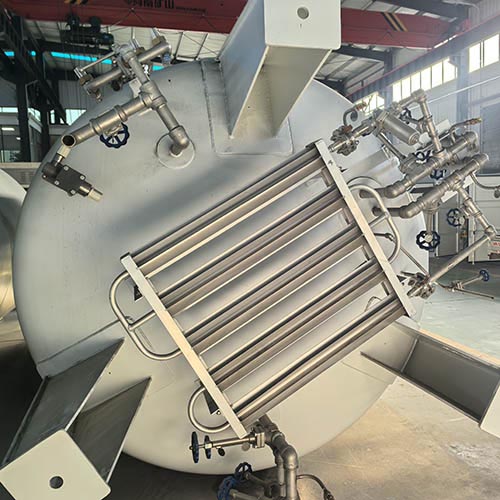
The difficulty of daily operation and maintenance varies greatly
Many factory equipment managers find it particularly easy to manage ordinary pressure vessels: they just need to read the pressure gauge every day and have the special inspection institute calibrate the safety valve once every half a year. As long as the pressure does not exceed the limit, there are basically no major problems.
But the operation and maintenance of cryogenic storage tanks is completely another logic. I once helped a client troubleshoot a fault. Their liquid nitrogen loss suddenly tripled. After a long investigation, it was discovered that the interlayer vacuum level had dropped. Ordinary maintenance personnel would not be able to detect this. Special vacuum testing instruments must be used to measure. Once the vacuum fails, the insulation layer will be directly ruined, and the pressure inside the tank will rapidly rise. The safety valve will frequently jump, not only wasting the medium but also bringing safety hazards of overpressure. Moreover, the pipeline valves of cryogenic tanks must use special types that can withstand low temperatures. Ordinary valves installed on them will leak due to low-temperature embrittlement after a few uses, with a very high risk.
The requirements for compliance regulation are completely different
Many people are unaware that cryogenic storage tanks are classified as “the most specialized of the specialized”. They not only need to meet all the regulatory requirements for pressure vessels, but also must additionally comply with the specific standards for GB/T 18442 for low-temperature insulated storage tanks. Ordinary pressure vessels can obtain the usage certificate by simply following the regular inspection process. However, cryogenic tanks require additional verification at every step from factory to installation, including checking the material reports of low-temperature materials, vacuum inspection records of the inner layers, and even the selection of safety valves must be adapted to the low-temperature conditions. They cannot simply use ordinary pressure vessel safety valves as substitutes. I have seen many small factories produce non-standard cryogenic tanks, skipping these inspections.