
Liquid Argon Practical Operation Guide: Real Use Experience from Basic Characteristics to Industrial Implementation
As a veteran professional in low-temperature gas equipment, I have witnessed too many factories stumble when they first used liquid argon: Some did not accurately calculate the vaporization volume and chose a smaller storage tank, causing the welding workshop to lose gas supply and delaying the entire batch of orders; Some did not install oxygen alarm devices, and a safety accident almost occurred in the confined space. Today’s article is entirely the practical knowledge I gathered from visiting hundreds of customer sites. There are no vague theories copied from the internet, but all are real and applicable content that can be used in the field.
Ⅰ. First, explain the basic knowledge of liquid argon clearly. Don’t be fooled by suppliers.
When many purchasers first come into contact with liquid argon, they immediately only ask about the price, and they haven’t even understood its most core physical properties. This easily leads to losses in purity and storage transportation.
Liquid argon is the transparent liquid form of argon gas formed at -185.9℃ under standard atmospheric pressure. The gas-liquid expansion ratio under standard atmospheric pressure is approximately 780 times. That means 1 cubic meter of liquid argon will completely vaporize and produce nearly 780 cubic meters of gaseous argon. You must remember this number, as it is crucial for calculating the daily gas consumption of the storage tank. Many small suppliers deliberately omit this parameter when reporting the tank volume, and you will only realize the actual supply duration is much shorter than expected when you start using it.
Its chemical properties are truly completely inert. With its outer layer of 8 electrons, it hardly reacts with any metals or common chemical raw materials, neither burning nor exploding. This is the core reason why it can be used as a protective gas in high-temperature industrial scenarios. But don’t let its inertness make you relax your vigilance. Two hidden risks of it have been overlooked by many people: One is that the -180+ degree low temperature directly touching the skin can cause deep frostbite within seconds; the other is that after a large amount of leakage, the vaporized argon gas is heavier than air and will sink in the low-lying areas of the workshop floor, silently displacing the oxygen and causing people to faint from lack of oxygen when they walk past without realizing it. I witnessed such an accident in a small hardware factory two years ago.
Ⅱ. Different industries’ real scenarios of using liquid argon, choosing the wrong purity is a pure waste of money.
I have seen too many customers blindly pursuing 99.999% high-purity liquid argon. However, when used in ordinary stainless steel welding, each ton costs several hundred more than expected, and the weld quality has no difference. This adds unnecessary production costs. Different scenarios have extremely different requirements for the purity of liquid argon. Choosing the right one can spend the money on the right place.
For ordinary hardware factories’ stainless steel argon arc welding and aluminum alloy plasma cutting, 99.99% pure liquid argon is completely sufficient. As long as the oxygen content is controlled within 100 ppm, it can avoid weld oxidation and discoloration, fully meeting the processing requirements of ordinary structural components. However, if it is used for weld seams in high-demand scenarios such as pressure vessels and nuclear power components, it must be upgraded to 99.999% high-purity liquid argon, with the oxygen content reduced to 1.5 ppm or below. Otherwise, weld seams are prone to gas holes and hydrogen embrittlement, and it cannot pass the flaw detection test.
For precision casting factories specializing in special high-temperature alloys and titanium alloys, liquid argon is not only used as a protective gas but can also be directly blown with small bubbles into the molten metal as a stirring gas, removing impurities in the metal liquid and significantly improving the casting yield. A precision casting customer in Jiangsu Province that I connected with last year previously used bottled argon gas. For one batch of melting, they had to change 8 bottles. After switching to centralized supply of liquid argon storage tanks, not only was the cost reduced by 30%, but the yield rate of castings also increased by 12%.
In semiconductor single crystal silicon pulling and chip etching such electronic-grade scenarios, the requirements for liquid argon are the most stringent. The basic purity must reach 6N or above, and the total impurities must be controlled at the ppb level. Even the pipelines must be made of 316L polished stainless steel material, with no trace of particle impurities allowed. Otherwise, it will directly lead to the scrapping of the wafers. Many customers who purchase semiconductor-related products have requested us to perform additional inner wall polishing on the liquid argon storage tanks to completely eliminate the possibility of impurity precipitation.
There are also many universities and research institutions’ cryogenic physics laboratories that use liquid argon as the cooling medium for superconducting equipment. In such scenarios, the gas consumption is generally not large, and a small-volume Dewar tank can meet daily usage needs without the need for a large storage tank.
III. Details for avoiding pitfalls in the daily operation of liquid argon are all lessons learned from on-site experiences.
Many online safety regulations are too general. I will tell you a few details that are most easily overlooked in actual operations and can help you avoid 90% of safety hazards.
When connecting the liquid argon pipeline, do not rush to start without wearing gloves that can withstand low temperatures. You must first put on cold-resistant gloves and then put on goggles. Once a customer did not wear goggles during operation and liquid argon sprayed out from the interface gap and splashed into the eye, it took nearly half a month to recover. When filling liquid argon, the speed must not be fast. The entire filling process must be at least 30 minutes. If filled too quickly, the pressure in the tank will suddenly rise, easily triggering the safety valve to release pressure, and a lot of liquid argon will be wasted.
In the area of the workshop where liquid argon is used, an oxygen concentration alarm should be installed at a height of 1 meter from the ground. Do not install it on the ceiling, because argon is heavier than air, and after leakage, it will sink to the lower part. If the alarm is installed too high, it cannot detect the oxygen deficiency environment at all, which is equivalent to installing it for no purpose. I have seen many factories that tried to save trouble and install the alarm on a high place on the wall, but it really failed to provide an early warning when there was a leakage.
When maintaining the liquid argon storage tank, if you find that the outer shell of the tank is covered with frost or sweat, do not take it lightly. This indicates that the vacuum degree of the tank’s inner layer has been damaged and the insulation performance has failed. The vaporization loss of liquid argon will directly increase several times. You must contact the equipment manufacturer to re-vacuum the tank immediately, otherwise, the liquid argon in the tank will be completely evaporated within a short time.
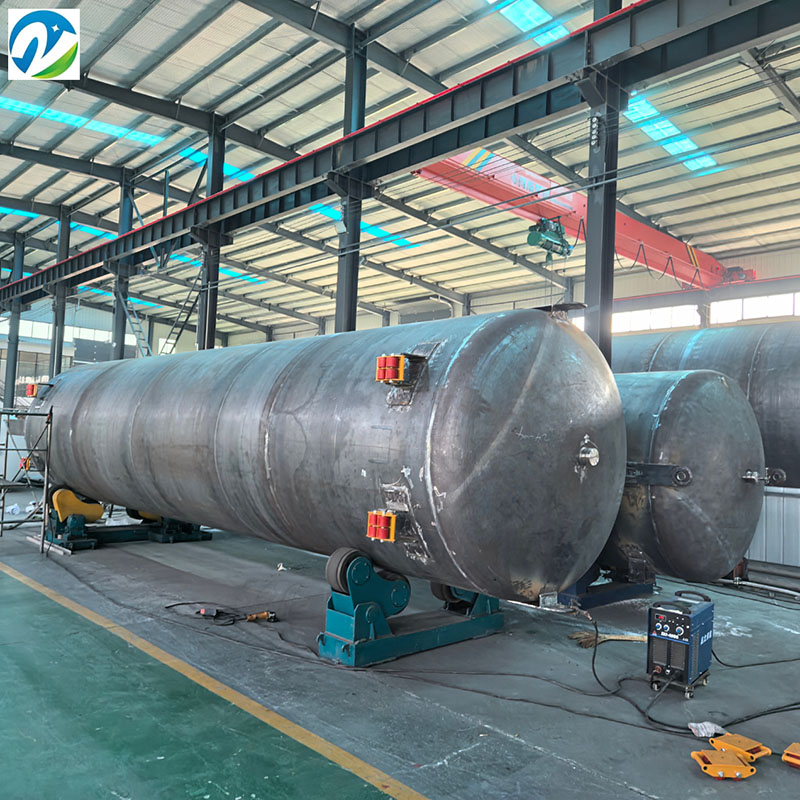
If you are building a centralized liquid argon supply system and do not know how to select the volume of the storage tank or how to match the flow rate of the vaporizer, please consult Zhuoyue Gas Equipment. We can provide you with a completely compatible low-temperature gas equipment solution based on your actual daily gas consumption and usage scenarios, helping you minimize your usage costs.