
In the global trend of replacing traditional energy sources with clean energy, LNG, due to its low emissions and long range, has become the mainstream alternative fuel for commercial vehicles, construction machinery, and port heavy trucks. Many overseas engineering contractors, logistics fleet operators, and small-scale energy investors, when initiating LNG refueling station projects, first come into contact with the core equipment, which is the LNG refueling station skid-mounted unit. Many people will first ask: What exactly is a skid-mounted unit? How is it different from traditional fixed refueling stations? This guide explains the core logic, advantages, and selection points of such equipment from the perspective of actual project implementation, helping you avoid initial cognitive misunderstandings in the project.
The actual definition of LNG refueling station skid-mounted units
LNG refueling station skid-mounted units are essentially a complete set of refueling equipment that integrates all core functional components on a unified steel base in the factory. Unlike traditional fixed refueling stations, the latter require one-by-one hoisting of tanks, welding of pipelines, installation of pump bodies and electrical control systems, and the construction work alone can take several months. The skid-mounted equipment, before leaving the factory, has completed 90% or more of assembly, low-temperature testing, and system debugging. After being transported to the site, users only need to prepare a flat load-bearing foundation, connect water and electricity, and external LNG gas sources, and within one or two weeks, they can complete the final connection and debugging and put it into operation directly.
This integrated design was originally developed to meet the needs of the oil and gas industry for rapid deployment of temporary refueling points. Now it has become the mainstream solution for small and medium-sized LNG refueling stations worldwide. Its core feature is “ready to use after installation, and can be moved at will”, which can be operated permanently at logistics parks, service areas, etc., or can be migrated as business changes, without having to scrap most facilities like traditional stations when relocating.
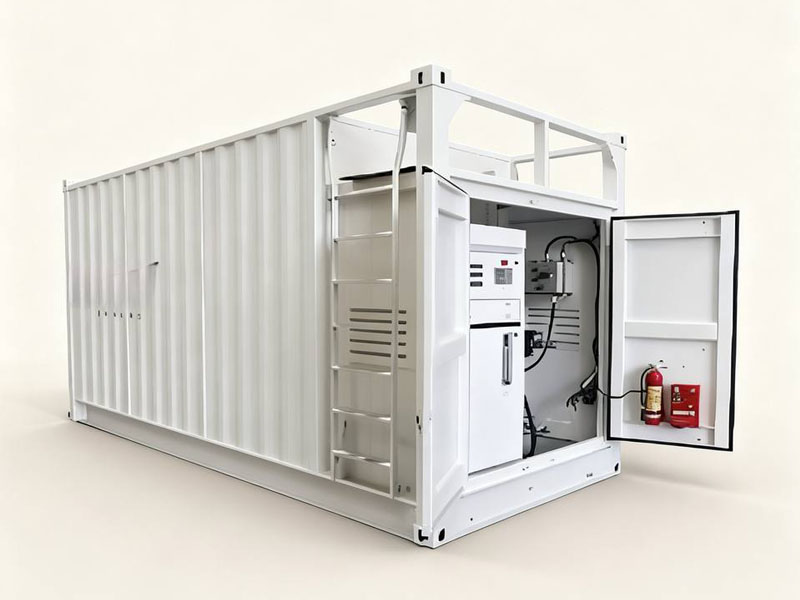
The five core components of skid-mounted equipment
Many people think that a skid-mounted unit is just a combination of several devices. In fact, its layout is an optimized low-temperature fluid system, and the position of each part and the direction of the pipelines have been verified through actual working conditions. The core is divided into five modules:
1. LNG low-temperature storage unit: It uses a dedicated storage tank with a high vacuum multi-layer insulation process, which can maintain a stable -162℃ low-temperature environment for a long time, controlling the natural evaporation loss of LNG at a very low level. The common custom volume ranges from 5 cubic meters to 60 cubic meters, and can fully meet the daily refueling needs of different-sized stations.
2. Pressure boosting refueling unit: The core components include a low-temperature submersible pump, high-precision refueling flowmeter, low-temperature refueling gun, and emergency shut-off valve. The entire refueling process is closed-loop automatic control, ensuring stable refueling flow and precise measurement of each refueling amount, avoiding the risk of low-temperature medium leakage.
3. Safety interlock control unit: This system is the core of the skid-mounted unit’s safety. It integrates combustible gas detectors, low-temperature temperature sensors, overpressure alarm devices, and a one-button emergency stop button. If there is a leakage, overheating, or overpressure anomaly on site, the system will automatically trigger interlock actions, cutting off the gas source immediately and controlling the risk at the bud stage.
4. Low-temperature process pipeline unit: All pipelines in contact with LNG are made of low-temperature-resistant stainless steel materials, and are externally wrapped with multiple layers of insulation materials. This not only avoids pipeline cracking in low-temperature environments but also reduces the intrusion of external heat, further reducing the evaporation loss during operation.
5.LNG supply pipeline unit: All LNG supply pipelines are made of low-temperature-resistant stainless steel materials, and are externally wrapped with multiple layers of insulation materials. This not only ensures the safety of the LNG supply but also reduces the risk of leakage.
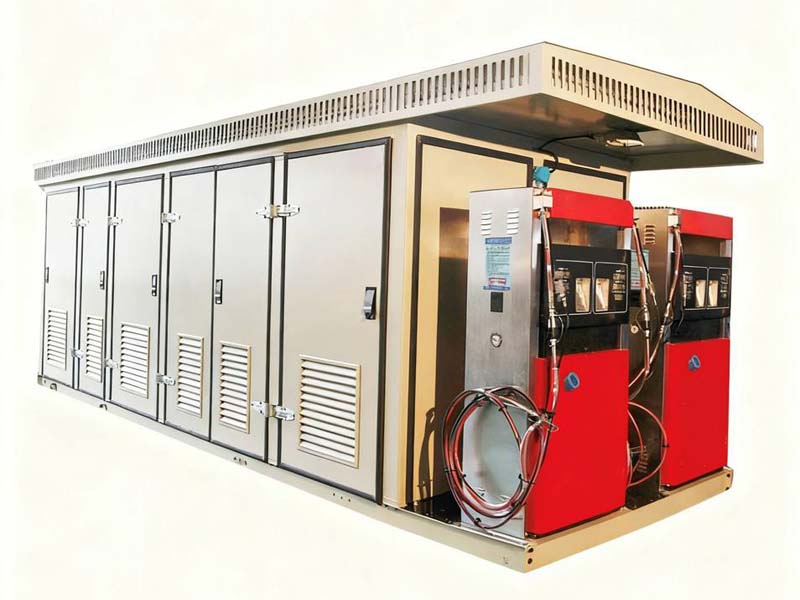
Practical Application Advantages of Skid-mounted Equipment
Compared with traditional fixed gas filling stations, the advantages of skid-mounted equipment are all derived from the actual project operation experience, without any abstract concepts.
Firstly, the construction period is significantly shorter. For a station of the same scale, the construction from civil engineering to commissioning usually takes at least 6 to 12 months, with a lot of time spent on on-site welding and pressure testing. Skid-mounted equipment is produced in the factory, and users only need to prepare the site foundation. After the equipment arrives at the site, the connection and commissioning can be completed in the shortest time of one week, and the operation can start in the same month to recover the cost.
Secondly, the site requirements are very low. Traditional gas filling stations need to build complex underground seepage pools and large areas of hardened ground. Skid-mounted equipment only requires a flat and load-bearing ground for installation, without complex underground engineering. Whether it is an idle land in a logistics park, a storage area at a port, or a temporary site in a remote mine, it can be smoothly deployed.
Thirdly, the investment pressure is much lower. For the same scale of skid-mounted stations, the total investment in the early stage is approximately one-third to one-half of that of traditional fixed stations. Moreover, the equipment is a movable asset, and if the fuel demand of this station decreases, the entire set of equipment can be pulled to a new location directly using a pallet truck, without the situation where a large amount of money is invested and the site is changed, resulting in a complete waste of resources.
Finally, the safety risk is much lower. Because 90% of the welding and connection work is completed in the professional workshop of the factory, the number of interface connections on-site is significantly reduced. From the root, it avoids leakage hazards caused by non-standard on-site construction, and during subsequent maintenance, all components are concentrated on a base, eliminating the need to search around, making fault detection and component replacement much more convenient.
For your liquefied natural gas skid-mounted station project, please directly contact Zhuoyue Gas Equipment to obtain customized solutions and quotations.