
I. The Core Logic of Selecting Cryogenic Storage Tanks
For purchasing customers in the overseas industrial gases, medical, and energy industries, the size of the storage tank is never just a set of numbers on the volume table. It directly affects the operational costs of the project, safety compliance, and also influences whether the long-term production will be smooth. Many purchasing parties initially set the specifications based on the estimated gas consumption, but after actual operation, they found that the filling frequency was increasing, the storage area was occupied to the fullest, and the evaporation loss was also high. After all these calculations, the overall life cycle cost was actually raised.
II. Core Factors Affecting Tank Size
1. Daily Average Consumption and Filling Cycle
This is the primary basis for determining the effective volume of the tank. In conventional industrial scenarios, the daily average consumption of liquid oxygen, liquid nitrogen, and liquid argon needs to be calculated based on the peak gas demand of the production line, while a 15%-20% redundancy is reserved to avoid supply risks during peak gas consumption periods. If the location of the purchaser is more than 2 hours’ drive from the gas supplier’s filling station, it is recommended to extend the filling cycle from the usual 3-5 days to 7-10 days. Correspondingly, the tank volume needs to be increased to reduce logistics costs and supply disruption risks from long-distance transportation. For LNG, some port projects will match the tank size with a reserve capacity of more than 30 days, serving as a core buffer unit for energy peak shaving.
2. Physical Properties of the Medium and Evaporation Rate Control Requirements
The boiling points of different low-temperature media vary greatly, with liquid hydrogen having a boiling point as low as -253°C and liquid oxygen at -183°C. The difficulty of thermal intrusion control is completely different for each. The insulation structure of the tank directly relates to the static evaporation rate indicator: a tank with a high vacuum multi-layer insulation structure can control the evaporation rate within 0.5% per day, allowing for a longer storage period under the same volume; if a vacuum powder insulation structure is selected, the evaporation rate is usually 1%-2% per day, and the tank volume needs to be appropriately enlarged to offset the effective storage loss caused by natural evaporation. Some EU projects with strict emission restrictions require zero-evaporation storage design, and the tank size needs to be reserved with buffer space for recovering BOG (evaporated gas) to avoid waste due to overpressure emissions.
3. Installation Space and Layout Constraints
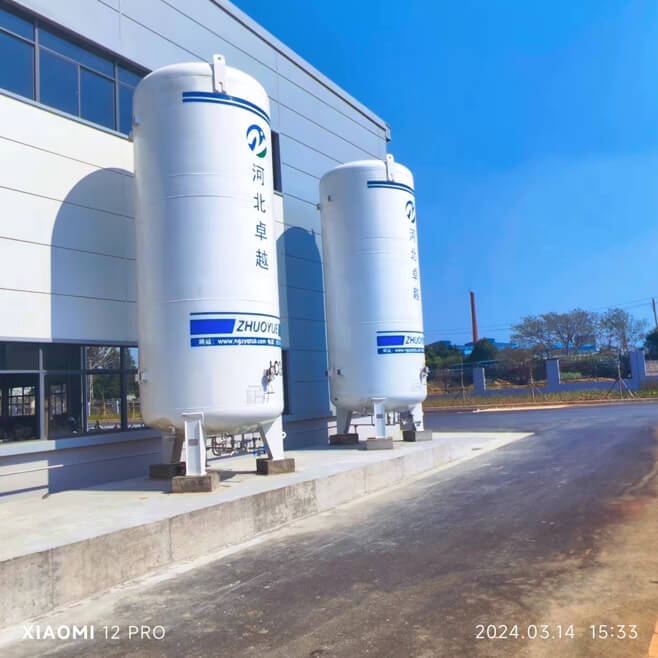
The available area of the purchaser’s factory is a hard boundary for tank selection. Vertical low-temperature storage tanks have a small footprint and are suitable for urban industrial parks with limited land resources. Under the same volume, they occupy only about 60% of the ground space compared to horizontal storage tanks; horizontal storage tanks are more suitable for low-rise factories or areas with height restrictions, facilitating the parallel layout of multiple tanks. Some overseas projects are restricted by local building codes, with a total tank height not exceeding 12 meters. Even if the calculated required volume is 50 m³, a conventional vertical structure cannot be used, and a combination of multiple small-capacity horizontal storage tanks is required to meet the demand. At the same time, safety operation spacing around the tank, gasifier installation space, and fire protection channels need to be reserved, which will inversely constrain the actual installable size of the tank.
4. Design Pressure and Structural Strength Limitations
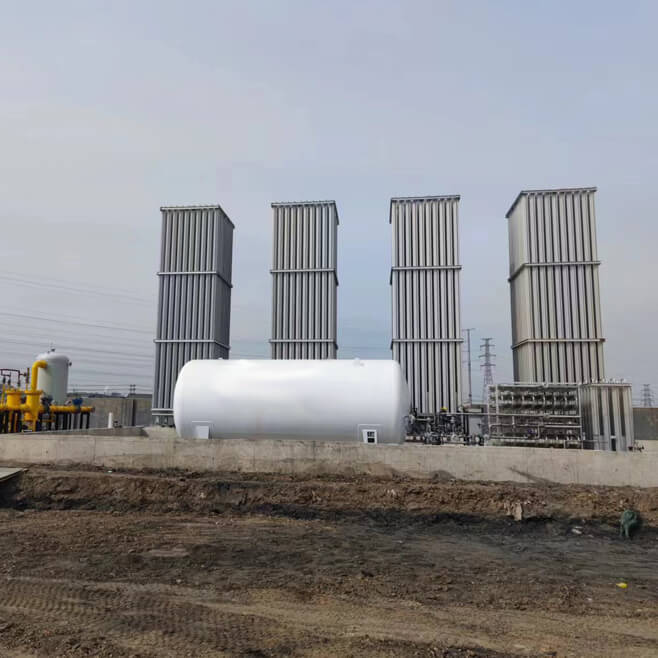
According to international pressure vessel standards such as EU PED 97/23/CE and US ASME BPVC VIII, the design pressure of the tank directly determines the wall thickness and structural weight of the tank. A 22 bar working pressure tank under the same volume has a wall thickness 40% thicker than a 8 bar conventional tank, resulting in a significant increase in the overall weight. Due to transportation weight limits and on-site lifting capacity constraints, the maximum allowable manufacturing volume of a single tank will be reduced accordingly. Large-volume low-pressure powder insulated storage tanks, with a working pressure of only 34-40 KPa, have a more lightweight structure and can achieve a volume of 2000 m³. Such large-volume tanks are only suitable for fixed gas source production bases and cannot be used as high-pressure gas supply terminals.
5. Compliance and Local Special Working Conditions Requirements
The engineering specifications of different countries and regions will directly affect the final determination of the tank size. For storage tanks in earthquake-prone areas (such as the UBC zone 3 seismic belt), the support leg structure needs to be strengthened additionally, and the height-to-diameter ratio of the tank will be limited within a reasonable range to prevent the overly tall tank from losing stability and tipping over during an earthquake; for projects in strong wind coastal areas, the design requirements for the external tank’s wind resistance pressure are thicker shell steel plates. Under the same volume, the overall diameter of the tank will be appropriately reduced, reducing the wind resistance load. For some chemical industrial parks with special explosion-proof requirements, the safety spacing between tanks is required to be no less than 1.5 times the diameter of the tank, which will also limit the maximum allowable diameter of a single tank to avoid occupying too much explosion-proof isolation area.
6. Life Cycle Cost Optimization
Many purchasers initially prefer to choose smaller-capacity storage tanks to lower the initial procurement cost, but they overlook the hidden expenses in the subsequent operation stage. An overly small tank will result in double the filling frequency, rapid increase in logistics costs and labor costs, and frequent filling and unloading operations will accelerate the wear and tear of valves and seals, shortening the equipment’s service life. Reasonably increasing the tank’s volume by 10%-15%, the initial procurement cost will only increase by less than 20%, but the filling cycle can be extended by nearly twice, and the additional investment can be recovered through the saved logistics costs within about 3 years, significantly reducing the overall long-term operating costs.
III. Practical Selection Suggestions
Before determining the size of the cryogenic storage tank, the purchaser is recommended to first collect the actual gas usage data for the past 3 months, combine the local filling logistics conditions, site plans and local engineering specifications, and work with the technical team of the equipment manufacturer to complete customized calculation. Avoid directly applying standard specification parameters, so as to select a cost-effective tank solution that meets current production needs and is suitable for future capacity expansion.
If you are unsure how to choose the appropriate tank size, you can contact the engineers of Zhuoyue, and we will provide you with a customized solution.