

Liquefied Natural Gas (LNG) storage tanks are the core equipment in the global natural gas supply chain. Their significance lies in safely storing LNG at a temperature of -162℃. LNG receiving stations, peak-valley regulation of urban gas, industrial self-supply gas sources, and even offshore energy platforms – wherever cryogenic gas is used, these infrastructures are almost indispensable. For enterprises using cryogenic gas equipment, there are various types of storage tanks, each with different structural characteristics, applicable scenarios, and performance advantages. A thorough understanding of these differences is crucial for ensuring safe, efficient, and economical operation of the project throughout its entire lifecycle, thereby increasing the confidence in its success.
I. Main Types of LNG Storage Tanks Classified by Structural Form
1. Prestressed Concrete Full Capacity Tank
This type of tank is the most widely used in large-scale onshore LNG receiving stations. It adopts a double-layer structure design: the inner layer is a low-temperature-resistant metal tank that directly contacts -162℃ LNG, and the outer layer is a high-strength prestressed concrete structure with an intermediate layer filled with efficient insulation and thermal insulation materials. Its core advantage is the full containment capability. Even if the inner tank has a slight leak, the outer concrete structure will completely absorb the medium and prevent it from spreading even a single step outward. The seismic resistance performance is extremely good, and it can handle extreme weather conditions without any problem. The capacity of a single storage tank can reach 160,000 cubic meters, and there is still room for further expansion. Such projects as large liquefied natural gas receiving stations and national-level energy strategic reserve bases, which have extremely high requirements for safety and storage and transportation capabilities, are precisely suitable for this.
2. Metal Double Shell LNG Storage Tank
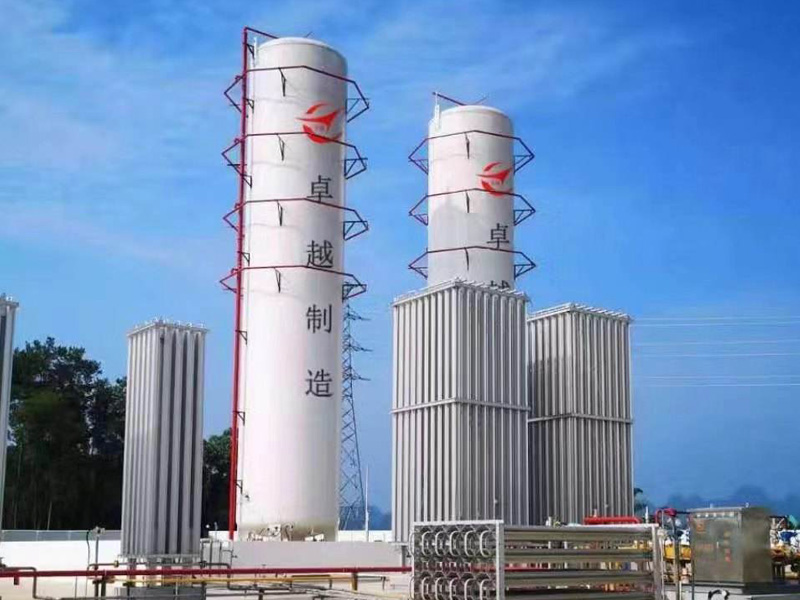
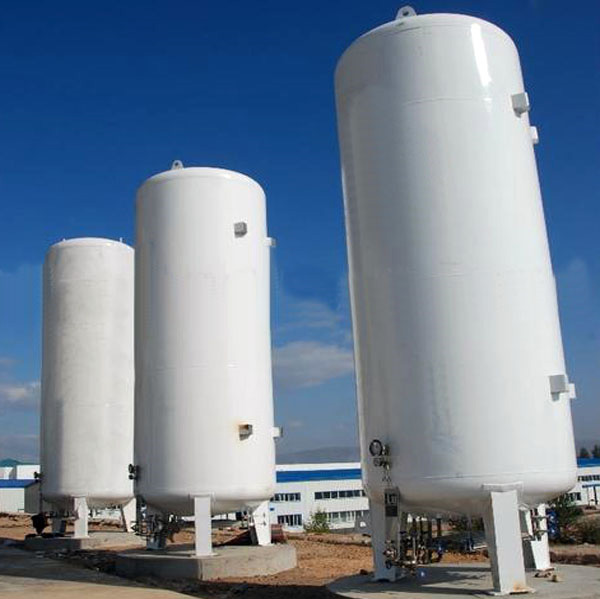
The inner and outer layers of this storage tank are both made of special low-temperature alloy steel. The insulation is achieved through the space between the two layers, which is filled with high-performance insulation materials such as expanded perlite and glass wool. Some designs also include a dry nitrogen gas filling in the inner layer to maintain a slight positive pressure, preventing moisture from invading and affecting the insulation effect. This type of tank has a shorter construction period, higher factory prefabrication degree, and lower on-site installation difficulty, making daily inspection and internal testing operations more convenient. Its capacity range is flexible, covering from a few hundred cubic meters for small industrial storage tanks to tens of thousands of cubic meters for medium-sized peak regulation storage tanks, and is widely applicable to urban gas peak regulation stations, industrial parks self-supply LNG gasification stations, and small-scale trade and distribution stations.
3. Underground and Pit-Type LNG Storage Tanks
These tanks place the tank body entirely in a ground-level pit, using the surrounding soil as an additional insulation layer to significantly reduce the speed of external heat intrusion into the tank and effectively reduce the natural evaporation loss of LNG. The soil covering structure itself has extremely strong resistance to external force damage and is almost unaffected by extreme strong winds, snowstorms, etc., and can also maximize the conservation of ground land resources, releasing more ground space for other production facility construction. They are particularly suitable for coastal LNG hubs with scarce land resources or core reserve projects with extremely high requirements for site safety levels. They are widely used in energy-importing countries with scarce land resources such as Japan and South Korea.
4. Double-Wall Cylindrical LNG Storage Tanks
Double-wall cylindrical tanks are a cost-effective choice for small-scale applications. There is a complete insulation layer between the inner and outer metal tanks, ensuring stable and reliable insulation efficiency. The overall design is modular, allowing for flexible capacity expansion according to project requirements. The structure is compact, the foundation construction difficulty is low, and it has strong adaptability to site geological conditions. Unlike large full-capacity tanks, it does not require special ultra-deep foundation treatment. These tanks are very suitable for offshore oil and gas platforms, remote mining areas temporary gas supply stations, LNG refueling stations, etc., which have limited space and installation conditions. They can be quickly deployed and put into use.
II. Special LNG Storage Tanks Classified by Application Scenarios
In addition to the classification by structural form, LNG storage tanks for different application scenarios also have targeted customized designs. For example, the on-board LNG storage tanks will adopt lightweight and high-strength structures to adapt to the vibration conditions during mobile transportation; the floating LNG storage tanks will additionally incorporate special designs for anti-shaking and anti-wave impact to ensure operational safety in the marine floating environment; the small-scale skid-mounted storage tanks will integrate the storage tank, pressure regulation, and safety release systems into a single skid, allowing them to be put into use upon opening the box, making them particularly suitable for temporary gas supply projects in remote areas.
For global purchasing customers of low-temperature gas equipment, when making a selection, one should not merely blindly pursue large capacity or low cost; instead, a comprehensive judgment should be made by considering the geological conditions, climate environment, storage scale, land cost, and long-term operation and maintenance capabilities of the project location. Zhuoyue, as a foreign trade service provider specializing in low-temperature gas equipment, can provide customized services from scheme design, production manufacturing to installation guidance for customers in different countries and regions. This helps each project match the most suitable LNG storage tank solution, ensuring long-term safe and stable operation while minimizing the overall cost throughout the project’s life cycle.