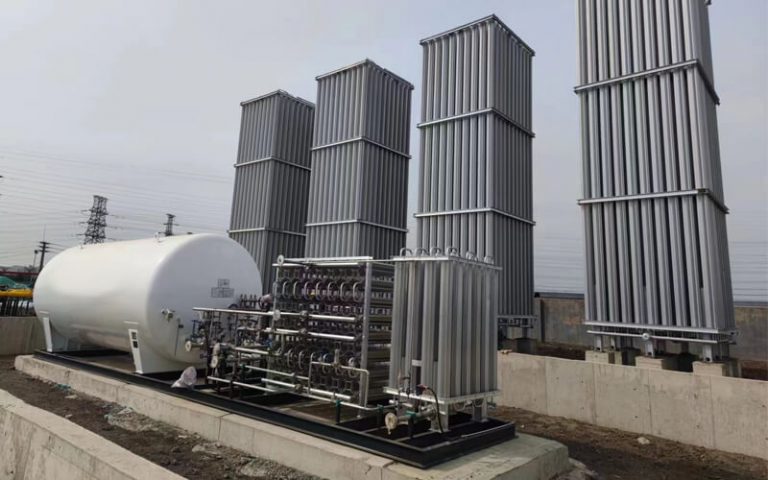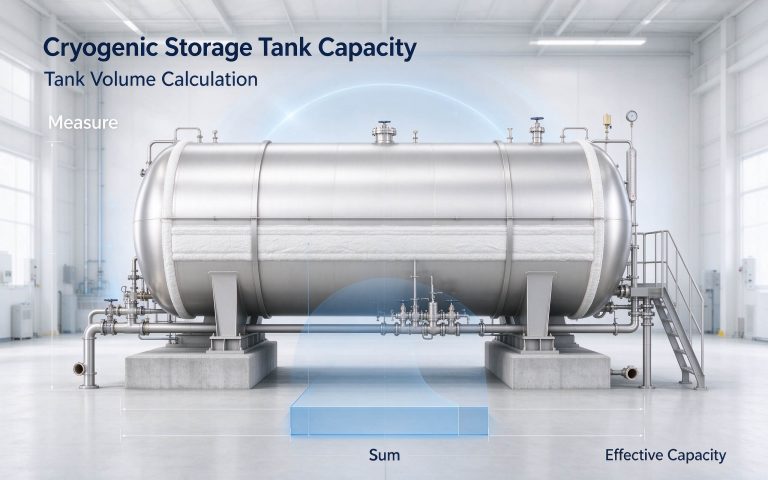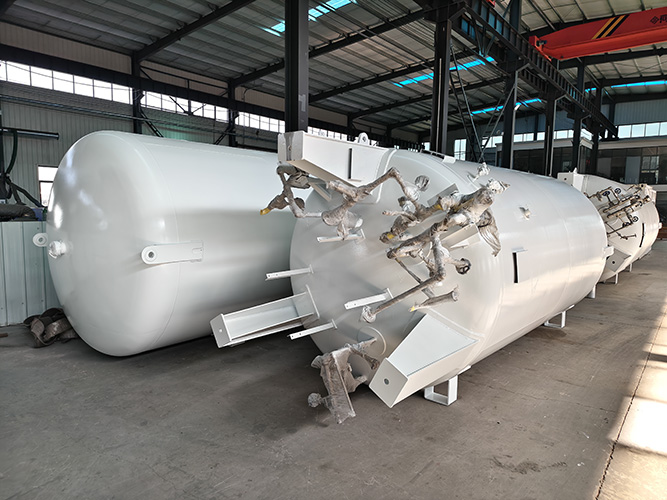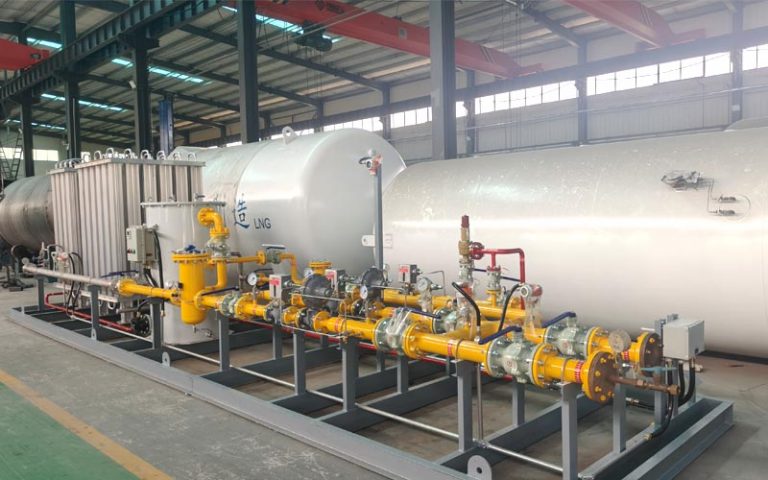

For LNG industry practitioners, the cryogenic storage tank is the most crucial storage carrier in the entire industry chain. Many people only know that it can hold liquid natural gas at -162 degrees Celsius, but they are not aware of the internal operation logic and safety design details. Unlike ordinary atmospheric pressure oil storage tanks, LNG cryogenic storage tanks, from material selection, structural design to daily operation control, every aspect is built around the core goal of “safe and stable operation at extremely low temperatures”. This is also the most concentrated manifestation of the technical strength of cryogenic gas equipment enterprises.
Ⅰ. The core underlying logic of LNG cryogenic storage
LNG is essentially purified and deeply cooled liquid natural gas. Under normal pressure, its boiling point is stably maintained at -162°C. Once the temperature rises significantly, it will rapidly vaporize and expand by more than 600 times. Without specialized cryogenic storage equipment, directly storing LNG in ordinary tanks would not only result in the waste of a large amount of gas but also pose safety hazards due to the sudden increase in pressure inside the tank. The core design concept of the cryogenic storage tank is to maximize the blocking of heat from the external environment through multiple layers of insulation structures, maintaining the temperature inside the tank at the boiling point range of LNG for a long time. At the same time, through precise pressure control systems, the small amount of evaporated gas generated by natural vaporization is smoothly discharged, neither causing an overpressure risk in the tank nor unnecessarily increasing the medium loss.
Ⅱ. The core internal structure of LNG cryogenic storage tank
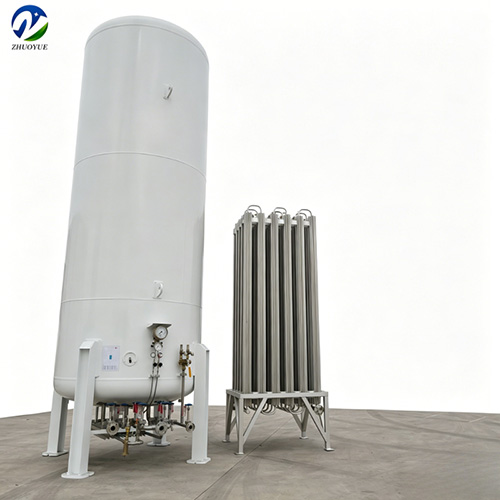
Most mainstream LNG cryogenic storage tanks almost all adopt the design of an inner and outer double-layer tank. The two layers of tanks are completely not in contact, and a dedicated insulation space is left in the middle. The inner tank is the part that directly contacts the -162°C liquid LNG and must not use ordinary carbon steel materials. The industry generally selects austenitic stainless steel with extremely strong low-temperature performance, which can maintain stable mechanical strength in a temperature range of nearly -200°C and will not experience low-temperature brittle cracking, perfectly meeting the requirements of LNG’s extremely low-temperature storage. The outer tank is mostly made of high-quality carbon structural steel. Its function is to provide sufficient structural strength for the entire tank and protect the insulation layer from being damaged by external water vapor and external forces. The insulation layer between the inner and outer tanks is the key to determining the insulation performance of the storage tank. Currently, the most commonly used combination scheme is “pearlite sand filling + high-purity nitrogen purging”, which, after special treatment, has an extremely low thermal conductivity and is combined with a slightly positive pressure nitrogen environment inside the insulation space, completely avoiding the entry of air and water vapor into the insulation space to form frost and ice, minimizing the heat transfer from the outside into the tank. Some high-end large LNG liquid storage tanks will also add multiple layers of aluminum foil insulation reflectors inside the insulation space to further weaken the heat radiation transfer, allowing the daily evaporation rate to be controlled within 0.05%.
Ⅲ. Pressure and temperature control mechanisms during daily operation
Even with the best insulation layer performance, it is impossible to completely block the intrusion of external heat. There will always be a small amount of natural vaporization of LNG in the tank, generating BOG (vaporized gas) evaporation gas. If this gas is not promptly treated, the pressure inside the tank will continue to rise, triggering safety protection devices. Under normal operating conditions, the pressure of the storage tank will remain within the set working range. When the pressure slowly rises to the upper threshold value, the corresponding BOG recovery system will automatically start, transporting the excess evaporation gas to the pipeline network or re-liquefaction device for recycling and reuse, without directly discharging it as waste. If extreme conditions occur, such as a sudden increase in ambient temperature or a prolonged period without discharging external fluids leading to a rapid rise in pressure, the dual safety valve assembly installed on the tank top will activate successively to release the excess gas and guide it to a safe area for discharge. The dual redundancy design completely eliminates the safety risks caused by a single valve failure. At the same time, high-precision platinum resistance temperature sensors are installed at different heights of the storage tank, allowing maintenance personnel to monitor the temperature changes of different areas within the tank in real time. If there is a local abnormal increase in temperature, they can immediately check whether there is a failure of the insulation layer or other equipment hazards.
Ⅳ. Details that Are Easily Ignored in Daily Maintenance
After a storage tank is put into operation, many users rarely pay attention to the changes in the nitrogen pressure in the annular space. In fact, this is the core indicator for judging whether the insulation performance of the storage tank is intact. If the nitrogen pressure in the annular space shows abnormal and continuous decline, it is likely that there is a minor leak in the outer tank body. After the outside water vapor slowly infiltrates the annular space, it will combine with the pearlescent sand to form frost, directly causing a significant reduction in insulation performance and ultimately leading to a significant increase in the daily evaporation rate of the storage tank. In addition, before the new tank is officially filled with LNG, the pre-cooling process must be strictly followed. It is not allowed to directly inject a large amount of low-temperature liquid directly into the tank at normal temperature. First, use low-temperature nitrogen to gradually lower the temperature of the tank body slowly to approach the boiling point of LNG. The entire pre-cooling process usually lasts for several hours to allow the temperature of the inner tank body to uniformly decrease, avoiding damage to the tank body structure due to a sudden temperature difference stress. For LNG low-temperature storage, from design and manufacturing to subsequent long-term operation, every detail control ultimately translates into a longer service life of the storage tank, lower operating costs, and higher safety coefficients. This is also the core capability that the low-temperature gas equipment industry has been constantly refining.