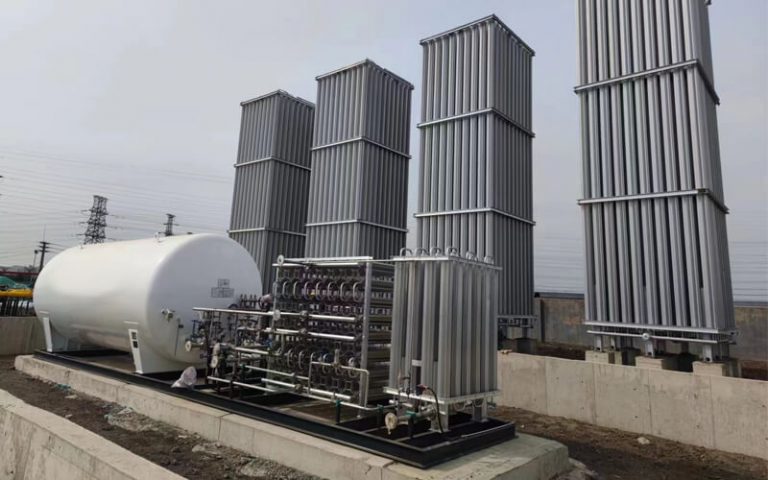

In import projects involving cryogenic gas equipment, micro bulk tanks are the core equipment that ensures the safe storage and stable transportation of cryogenic media such as liquid oxygen, nitrogen, and argon. Their quality directly determines the efficiency of project implementation, long-term operational safety, and subsequent maintenance costs. Many foreign purchasing managers have encountered similar dilemmas: when screening from a large number of supplier information, they either encounter manufacturers with quotations far below industry standards, only to find after delivery that the weld seams of the tank have hidden defects or the insulation layer fails to meet the insulation performance standards; or the customized parameters promised by the manufacturers are reduced at will during actual production, resulting in the final product failing to pass the special equipment certification of the destination country, causing the entire batch of goods to be detained at the port and incurring high detention fees, and the project progress being forced to be postponed for several months.
To avoid these purchasing traps and find truly suitable reliable micro bulk tank manufacturers for imported projects, one cannot rely solely on the ranking of keywords in online searches. Instead, it is necessary to verify each layer from the core dimensions of compliance qualifications, full-process production control, and cross-border project service capabilities. Only by doing so can one select high-quality partners that can be long-term compatible with the imported project.
Ⅰ. First step: Verify the compliance qualifications for the target market
For imported projects, qualifications are not the “glory decoration” used by manufacturers for promotion, but the basic threshold for the smooth customs clearance and legal use of the goods in the destination country. Many purchasing managers often make the mistake of only requiring manufacturers to provide domestic production qualifications, but ignoring the exclusive entry requirements of the target market. When the goods arrive at the port, they find that they lack necessary certifications, and can only face the passive situation of returning or rectification.
Reliable micro bulk tank manufacturers must simultaneously possess core qualifications for pressure vessel manufacturing and corresponding special certifications for export markets: for example, for projects targeting the European market, the manufacturer must have a complete PED directive certification, and the design, welding, and testing of the tank must comply with the EU pressure equipment standards; for projects targeting the North American market, ASME U stamp is a mandatory requirement, and corresponding registration documents must be provided, so as to pass the local special equipment regulatory authorities’ acceptance. In addition to these core certifications, it is also necessary to verify the manufacturer’s ISO 9001 quality management system certification, special inspection reports on low-temperature insulation performance, and even require the manufacturer to provide copies of customs clearance documents from previous similar imported projects in the region to confirm that their qualification documents are not temporary and invalid materials.
Ⅱ. On-site or remote verification of production process control capabilities
Having complete qualifications only indicates that the manufacturer has the basic production qualifications. What truly determines the long-term stability of micro bulk tanks is the detailed control of each production process. Many small factories can obtain basic qualifications, but in actual production, in order to reduce costs, they replace the designated low-temperature special steel with ordinary carbon steel or significantly reduce the vacuum treatment time of the insulation layer, resulting in a daily evaporation rate far exceeding the contract agreement, and subsequent operating costs soaring.
Purchasing managers with the conditions can arrange on-site inspections, focusing on three core aspects: first, the traceability record of the material before steel cutting to confirm that each piece of low-temperature steel plate used in the tank has a complete original material certificate that matches the design drawings’ parameters; second, the control of the welding process. Reliable manufacturers will assign a dedicated welder number to each weld seam and provide complete non-destructive testing reports, with no cases of missed inspections or proxy inspections; The third step is the vacuum insulation treatment process. Advanced manufacturers have fully automated vacuum pumping systems that can ensure the long-term stability of the vacuum level of multiple insulation layers. Before leaving the factory, they will conduct continuous cold protection tests for 72 hours or more, and issue corresponding daily evaporation rate test reports. If on-site factory inspection is not possible, the manufacturer can be requested to provide real-time video records of the entire production process, from steel plate cutting to final product pressure testing, to ensure that every key node is confirmed simultaneously, avoiding the situation of “what you see is not what you get”.
Ⅲ. Focus on the exclusive service capabilities of cross-border projects
The import project of micro bulk storage tanks is not a simple “pay money and get the goods” transaction. From the early stage of parameter customization, packaging and transportation, to the later stage of on-site commissioning and after-sales response, the full chain service capabilities directly affect the landing experience of the project. Many purchasers have reported similar bad experiences: The manufacturer only takes charge of production according to the drawings, completely not understanding the rust prevention and vacuum protection requirements for exported goods. After the goods have been transported for several days by sea to the destination port, it is found that the interface of the tank is rusted and the vacuum level has failed, and only local high-cost rework is possible.
Trustworthy manufacturers will configure exclusive cross-border service teams for import projects: In the early stage, they will combine the installation site conditions in the destination country and the local gas filling standards to optimize the volume, interface configuration, and safety accessory selection of the tank to avoid problems where the product cannot adapt to the on-site conditions after arrival; In the packaging stage, they will use export-specific vacuum rust-proof packaging, providing special protection against high salt spray and high humidity environments during the shipping process, and will retest the tank vacuum level before shipment and issue a third-party test report to accompany the goods; In the after-sales aspect, they can provide multilingual installation guidance manuals, support remote video debugging, and set up exclusive spare parts warehouses for different regions of customers, even for projects far away overseas, they can respond to after-sales needs within 72 hours and will not encounter the situation of not being able to contact the manufacturer after the goods are delivered.
Finally, Zhuoyue Gas Equipment reminds all import project purchasers that when choosing a micro bulk storage tank manufacturer, do not blindly pursue the lowest price in the market. A qualified micro bulk storage tank should invest sufficient costs in steel material costs, welding inspection, vacuum treatment, and export compliance protection. A quote far below the industry average must be a compromise in a certain key aspect. Only by thoroughly verifying the three dimensions of qualification compliance, production control, and cross-border service can one find truly reliable and long-term cooperative reliable manufacturers, allowing the low-temperature gas import project to avoid risks and smoothly land.