
The Working Principle, Core Components and Application Scenarios of Ambient Air Vaporizers
In the supply chain of cryogenic liquid gases such as liquefied natural gas (LNG), liquid oxygen (LOX), liquid nitrogen (LIN), and liquid argon (LAR), the gasification process always plays a crucial role as the “final touch”. The ambient air vaporizer (Ambient Air Vaporizer, abbreviated as AAV) with its outstanding advantages of zero energy consumption and low operation costs is becoming the mainstream solution favored by the global cryogenic gas industry. This article will analyze the underlying logic of this technology from three dimensions: working principle, core components, and practical applications.
I. Working Principle: “Borrowing” Heat from the Air
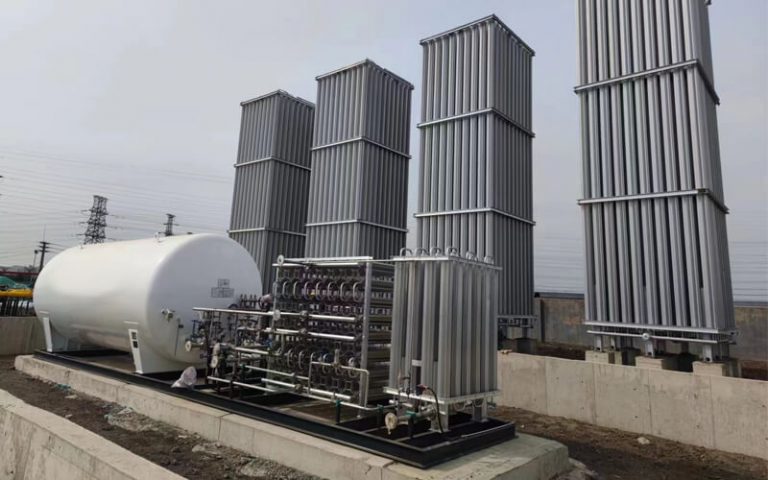
The core idea of the ambient air vaporizer is extremely simple – using the atmosphere as a heat source and achieving heat exchange through aluminum alloy finned tubes to heat the cryogenic liquid gas to a gaseous state or even an overheated state.
The operation process can be summarized as three steps: The liquid gas enters the finned tube from the pipeline and flows inside, absorbing heat; The ambient air naturally flows over the surface of the finned tube, transferring heat to the tube wall; The liquid temperature gradually rises, and the phase change of gasification is completed, with the gas output in gaseous form.
It is worth noting that the natural ventilation type AAV does not require any external power drive and relies entirely on natural convection to complete heat exchange, with operating costs (OPEX) approaching zero. While the forced ventilation type uses a fan to enhance air flow speed and increase gasification capacity, it also increases power consumption and maintenance expenses.
From the perspective of heat transfer mechanism, the heat transfer follows the path of “internal convection in the tube → heat conduction on the tube wall → external finned tube convection”. The internal convection heat transfer of LNG in the tube can be calculated using the correlation formula for internal forced convection experiments; The air side outside the tube can be regarded as natural convection in a large space, and a single finned sheet is approximately an isometric straight-rib heat exchange model. When the cryogenic liquid flows upward in the tube, the liquid near the inner wall of the fin first absorbs heat and vaporizes to form micro-bubbles, which then gather and separate to form a boiling state. To improve heat transfer uniformity, new finned tubes with built-in liquid absorption cores and spiral guide strips have been developed – the liquid absorption core uses capillary action to form a liquid film on the tube wall, promoting the generation of micro-bubbles; The spiral guide strip extends the liquid path, allowing gas and liquid to be fully separated, significantly improving the overall heat transfer coefficient.
II. Core Components: Every Part Cannot Be Ignored
A mature ambient air vaporizer is not a simple “tube plus fins”, and its system integration is far beyond imagination.
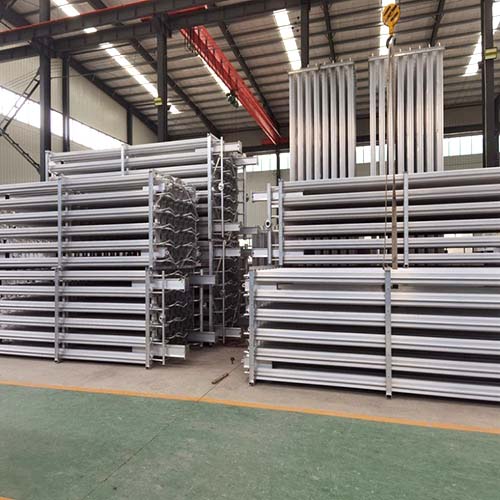
The finned tube group is the core of heat exchange, and low-pressure equipment mostly uses all-aluminum finned tubes, while high-pressure equipment uses aluminum finned tubes combined with stainless steel core tubes to withstand higher working pressure. Main production manufacturers are concentrated in Jiangxi, Zhejiang, and Guangdong provinces, and some enterprises have achieved an output of 8000 Nm³/h per unit.
The gasification section and the superheating section have clear divisions of labor: The gasification section completes the phase change from liquid to gas, while the superheating section further increases the gas temperature to meet the requirements of downstream processes.
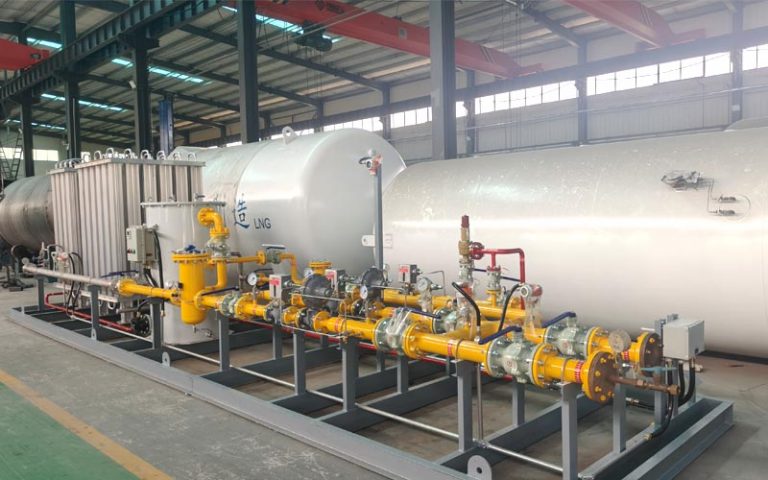
The control and safety system is also crucial, including main pressure regulating devices, liquid phase monitoring pressure regulators, gas phase pressure regulating systems, over-liquid prevention devices, and safety vent pipes, ensuring safe and stable operation within a pressure range of 0.6 to 30 MPa.
In addition, for the problem of reduced heat transfer efficiency due to frost formation on the fin surface in low-temperature environments, the new needle-rib structure provides an ingenious solution – when the frost layer diameter does not exceed the critical thermal insulation diameter (approximately 30mm), the heat transfer performance actually improves; When wind blows over it, it may achieve self-cleaning deicing through Karman vortex resonance, which is an engineering wisdom of “treating frost with frost”.
III. Application Scenarios: From Gas Stations to Large Receiving Terminals
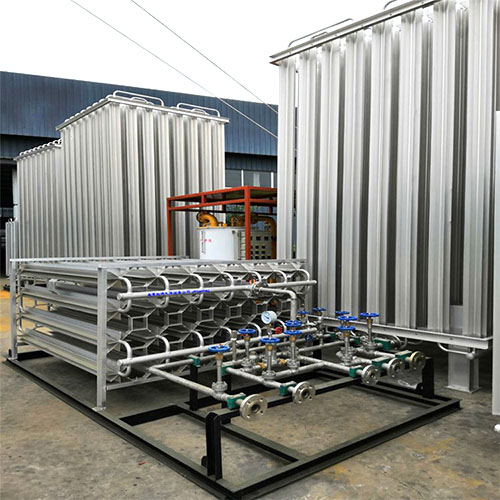
The application scope of ambient air vaporizers is expanding rapidly. In small-scale LNG gas stations, the natural ventilation type AAV, with its zero fuel consumption and zero carbon emission environmental characteristics, has become the preferred choice. At large LNG receiving terminals, multiple AAVs operating in parallel can meet the massive gasification demands. In the industrial gas sector, the supply of gases such as LOX, LIN, LAR, CO₂, and C₂H₄ also cannot do without this technology.
Of course, AAV is not all-powerful. Its production capacity is greatly affected by environmental temperature, wind speed, and humidity. In extremely cold regions, a backup heating system needs to be configured to ensure the continuity of gas supply. For peak load regulation or small-scale stations with weak infrastructure, electric heating gasifiers (EHV) or water bath/steam heating gasifiers (WHV/SHV) might be more reliable supplementary solutions.
Last point: The air-cooled gasifier employs the simplest physical principle and addresses the most fundamental and crucial aspect of the cryogenic gas supply chain. Choosing the appropriate gasification technology essentially involves finding the optimal balance among efficiency, cost, and environmental protection. If you are evaluating the equipment solution for a cryogenic gas project, please feel free to contact Zhuoyue Gas Equipment at any time to obtain customized technical support.