For enterprises engaged in precision manufacturing, high-end research, and special engineering worldwide, liquid argon is no longer an unfamiliar industrial term. As an inert cryogenic liquid extracted from air separation processes, it is becoming a key medium for ensuring production safety and product quality in an increasing number of high-end scenarios. Today, we will start from actual industrial applications and outline the core usage scenarios of liquid argon. At the same time, combined with first-line operational experience, we will share a set of directly applicable liquid argon storage and management standards to help overseas customers effectively utilize the performance advantages of liquid argon in daily operations while also adhering to the safety bottom line for the use of cryogenic gases.
1. Core Industrial Application Scenarios of Liquid Argon
The value of liquid argon lies in its two indispensable characteristics: first, as an inert gas, it hardly reacts chemically with any conventional industrial materials; second, as a cryogenic liquid, it can stably maintain an ultra-low temperature of around -186℃. These two features make it a necessary medium in multiple high-demand industries.
In the traditional metal processing field, the vaporized liquid argon obtained from it is the core protective gas for argon arc welding. During the welding process of stainless steel, aluminum alloy, and titanium alloy, the high-temperature molten pool, once in contact with air, will oxidize, forming pores, cracks, and other defects that directly reduce the structural strength. By introducing a continuous and stable argon gas protection layer, it can completely isolate oxygen and nitrogen, allowing the weld seam to form a smoother shape and achieve the design standard in terms of mechanical properties. In production lines with strict welding quality requirements such as automotive bodies, construction machinery, and pressure vessels, stable liquid argon supply is the basic prerequisite for ensuring batch yield.
The rapidly growing photovoltaic and semiconductor industries are becoming the new core engines of liquid argon demand. In the pulling process of single-crystal silicon and polycrystalline silicon, the entire furnace needs to be filled with high-purity argon gas as a protective atmosphere to prevent silicon materials from being contaminated by impurities at high temperatures. In the ion implantation and sputtering coating processes of chip manufacturing, ultra-high-purity liquid argon above 99.999% is indispensable, even a tiny amount of impurities can directly lead to the scrapping of the wafer. In such scenarios, the purity stability and continuous supply capacity of liquid argon directly affect the operational efficiency of the entire production line, and it is also the core consideration for many high-end manufacturing enterprises to choose a long-term cooperation liquid argon service provider.
In research and analysis laboratory scenarios, the cryogenic advantage of liquid argon is fully utilized. It is a common cooling medium for precision analysis equipment such as spectrometers, gas chromatographs, and mass spectrometers, helping detectors maintain a stable ultra-low working state, significantly improving detection accuracy and data reliability. Many cutting-edge experiments in low-temperature physics and materials science also use liquid argon to create controllable low-temperature environments, testing the physical properties of new materials under extreme temperatures. Such applications have extremely high requirements for the purity of liquid argon and the absence of impurity intrusion during the storage process.
In addition, special metallurgy in aerospace, inert protection cabins for 3D printing, special preservation packaging in the food industry, and cryogenic crushing, liquid argon is also playing an indispensable role in these scenarios. Due to covering so many high-value fields, the stable supply and standardized storage of liquid argon have become an operational aspect that global industrial users must pay attention to.
2. Core Safety and Stability Requirements for Liquid Argon Storage
Many overseas customers tend to overlook the details of liquid argon storage in their daily operations, ultimately leading to unnecessary safety hazards and material losses. Based on years of first-line experience in providing supporting services for cryogenic gas equipment, we have summarized a set of directly executable storage standards covering all key points from environmental layout to daily inspections throughout the process.
The first is temperature and environmental stability control. The standard boiling point of liquid argon is -185.7℃. The most crucial aspect during storage is to avoid significant fluctuations in ambient temperature. Intense temperature changes will accelerate the vaporization of liquid argon, directly causing abnormal pressure increases within the tank and increasing safety risks. The storage area should be far from direct sunlight and should not be located near heat sources, steam pipes, or high-temperature equipment. It is advisable to keep the ambient temperature within a relatively stable range.
Secondly, strictly control the environmental humidity. The storage area must be kept dry and well-ventilated. Water vapor must not enter the liquid argon tank. In a low-temperature environment, water vapor entering the tank will quickly freeze, causing minor blockages in pipelines and valves, or even severe damage to the insulation performance of the equipment and potentially leading to sealing failure. During daily storage, regularly inspect the sealing components of the tank. During rainy seasons or high-humidity areas, the inspection frequency should be increased.
Thirdly, ventilation and space safety management. Liquid argon is non-toxic, but if a leak occurs, the vaporized argon has a higher density than air and will accumulate in low-lying areas, gradually reducing the oxygen concentration in the air. In severe cases, it may cause asphyxiation. Therefore, the storage area must be equipped with a continuous and effective forced ventilation system. Liquid argon tanks must not be stored in enclosed basements or enclosed rooms without ventilation. At the same time, clear safety warning signs should be set up in the area, and sufficient evacuation routes should be reserved to prevent unauthorized personnel from entering.
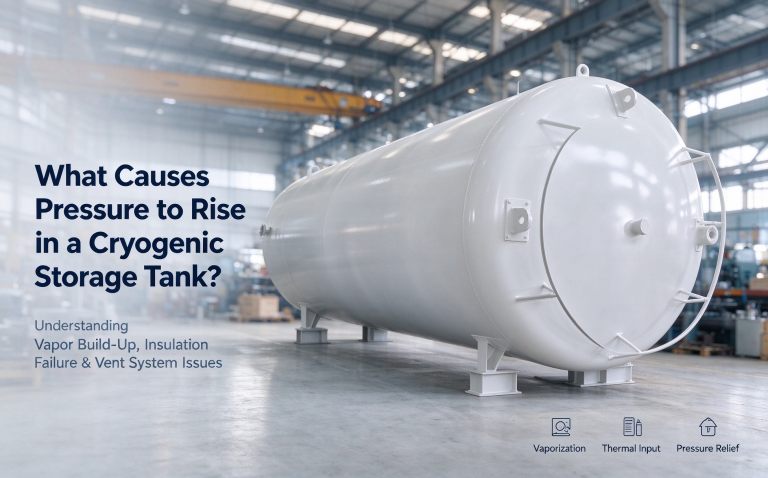
Fourthly, requirements for hazard source isolation. The liquid argon storage point must maintain a sufficient safety distance from all open flames, heat sources, and flammable and explosive materials. In case of an unexpected situation causing the tank to rapidly heat up, liquid argon will vaporize in large quantities within a short period, causing the pressure inside the tank to rise sharply. In severe cases, it may lead to overpressure discharge or even more serious safety accidents. Dividing the storage of liquid argon from flammable and explosive materials is a fundamental measure to avoid chain risks at the source.
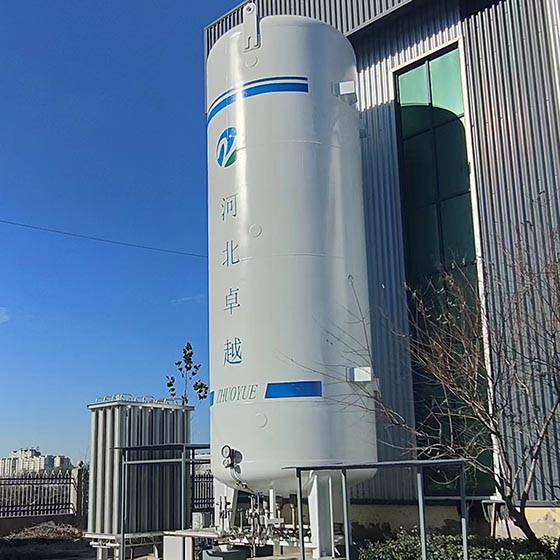
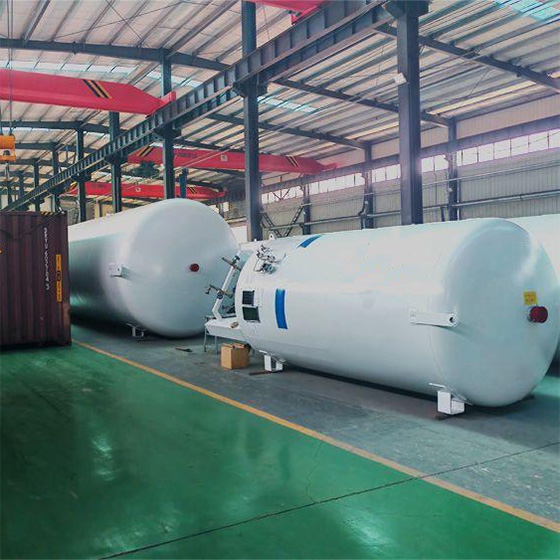
Finally, protection and operation of the tank itself. Liquid argon tanks are double-layered pressure vessels. During daily placement, proper anti-collision protection should be provided for the periphery to prevent accidental collisions with the tank by forklifts or handling equipment, which may damage the vacuum insulation layer. The operation team should establish standardized daily inspection forms, regularly record the pressure, liquid level, and appearance status of the tank, and all personnel in contact with liquid argon must complete systematic safety operation training and be familiar with emergency response procedures before they can start working.
For industrial users worldwide, the value of liquid argon is not simply purchasing a batch of cryogenic liquids, but obtaining a stable, safe, and equipment that meets their own process requirements. Zhuoyue Gas Equipment, as a supplier specializing in cryogenic gas equipment and related services, also always recommends that all overseas customers, when choosing liquid argon supply and storage solutions, first clarify purity, usage volume, and operation requirements based on their industry scenarios, and then match the corresponding tank specifications, delivery schedule, and safety training services to make liquid argon truly become a reliable support in production and operation, rather than a potential risk point.