
In the export supply chain scenario of low-temperature gas equipment, many overseas industrial customers frequently come into contact with Gas Pressure Regulating Skid, which is a core equipment consisting of gas pressure regulating, filtering, safety protection, and status monitoring functions. However, many customers who are making their first selection often lack a clear understanding of its complete definition, core value, and applicable scenarios, which can lead to problems such as poor system compatibility and excessive operation costs during project implementation. As a manufacturer specializing in the research and supply of low-temperature gas equipment, based on our actual industry project implementation experience, we will thoroughly break down the core content of the Gas Pressure Regulating Skid for you, helping you make more practical decisions during the project selection stage.
I. Basic Definition and Core Positioning of Gas Pressure Regulating Skid
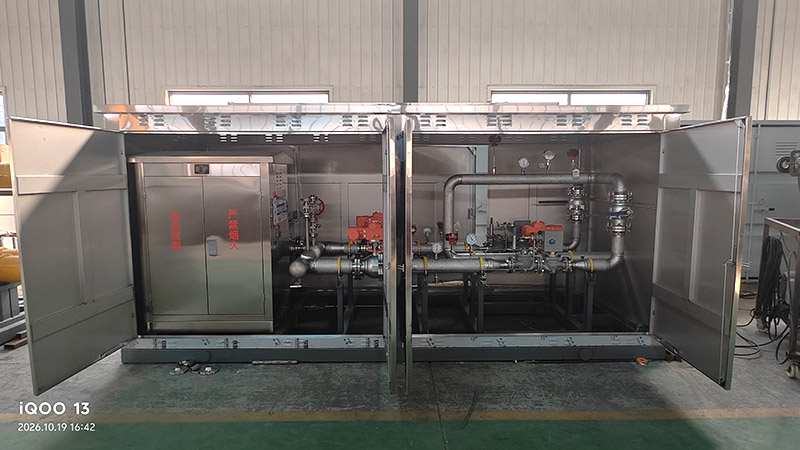
A Gas Pressure Regulating Skid can be understood as a highly integrated gas pressure regulation unit. It is not merely a pressure reducing valve device; instead, it integrates all these functional modules such as pressure regulation, filtration, safety protection, and status monitoring onto a single skid-mounted base. When it leaves the factory, it is a complete independent unit, delivered as a whole.
Unlike scattered purchased pressure regulating components, this equipment has completed all module assembly, debugging, and pressure testing before leaving the factory. Upon arrival at the project site, it only requires connecting the inlet and outlet pipelines and the power supply system to be put into use, significantly reducing the on-site construction workload.
Its core positioning is the “pressure stability hub” in the gas transmission pipeline network. Whether it is the main pipeline regulation of urban gas gate stations, the centralized gas supply system in industrial plants, or the terminal pressure adaptation stage after the liquefied gas is vaporized, the Gas Pressure Regulating Skid can precisely and stably regulate the fluctuating high-pressure gas to the pressure range that downstream equipment can safely use, ensuring that the entire gas supply chain remains in a safe and efficient operating state.
II. Core Components and Operating Logic of Gas Pressure Regulating Skid
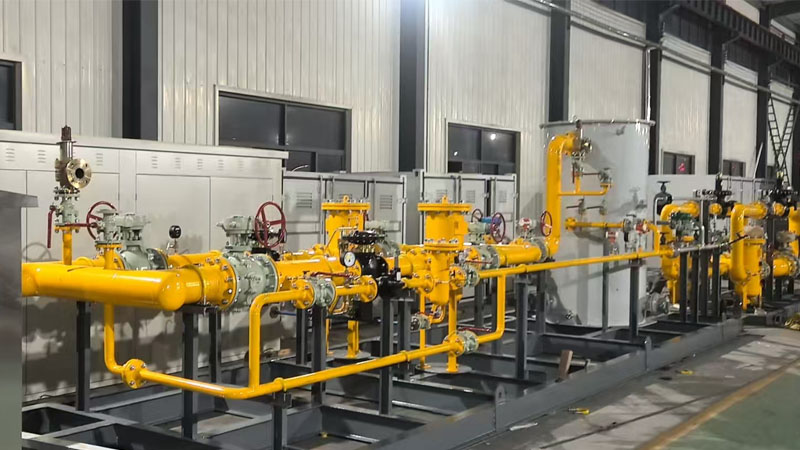
A standard industrial-grade Gas Pressure Regulating Skid is designed with all component configurations centered around the core goal of “stable pressure control and safety guarantee”. The core components can be divided into five modules:
Pre-treatment Module: It mainly includes high-precision gas filters and pre-purging components, used to filter out dust and liquid impurities in the upstream gas to prevent particles from entering the subsequent pressure regulating components and causing valve seat scratches, sealing failure, etc., thereby extending the overall equipment’s service life. For low-temperature gas scenarios, some customized models will also be equipped with a pre-replacement heat unit to adjust the temperature of the gas after liquefaction to the suitable range for the pressure regulating elements, avoiding the impact of low-temperature media on the sealing performance.
Let’s look at the main pressure regulating module first. The entire equipment’s regulation task is mainly undertaken by it. This module internally adopts a pilot-type pressure regulating element, forming a high-precision pressure negative feedback regulation loop. The specific configuration as single-stage or multi-stage depends on the working conditions. When the outlet gas consumption suddenly increases or the upstream inlet pressure fluctuates, the sensing element will immediately detect the pressure change and automatically drive the pressure regulating valve to adjust the valve opening, keeping the outlet pressure always stable within the preset error range.
Then, let’s talk about the safety protection module. It is equipped with an overpressure automatic cut-off valve and a safety vent valve, forming a dual protection structure. Once the downstream pressure exceeds the set safety threshold, the cut-off valve will immediately act, cutting off the gas path, and the vent valve will also follow to safely discharge the overpressure gas. Thus, the risk of damage to the downstream pipeline or gas-using equipment due to overpressure can be eliminated at the source.
The monitoring and control module is well integrated. High-precision pressure gauges, pressure transmitters are included, and the flow measurement unit is selected as needed. The operating data such as inlet and outlet pressure and instantaneous flow can be uploaded in real time, supporting local on-site display as well as remote platform transmission. Maintenance personnel can access the current operating status of the equipment at any time.
Finally, the skid-mounted base is integrated with the pipeline.The base is made of high-strength carbon steel or stainless steel in an integrated structure. All the pipelines and valves have undergone standardized welding and air-tightness tests before leaving the factory. The entire device has a compact structure and occupies much less space than the scattered assembly of pressure regulating systems on-site.
The operation logic of the entire equipment is entirely based on the energy of the medium itself for regulation, without the need for additional large-power drive devices. It achieves dynamic pressure stabilization through an internal force balance mechanism, with extremely low operating energy consumption. The stability and reliability of long-term use have been verified through numerous industrial projects in practice.
III. Main Application Scenarios of Gas Pressure Regulating Poles
From civilian gas transmission to high-end industrial production, the adaptable scenarios of pressure regulating poles cover the vast majority of supply systems that require stable gas pressure. The most common three application scenarios include:
The first is urban gas transmission and distribution networks. As the core equipment of gate stations or regional distribution stations, it gradually reduces the high-pressure natural gas from long-distance pipelines to stable pressure for downstream residential areas, commercial users, and industrial zones, ensuring the stable pressure of the entire urban gas pipeline network.
The second is industrial centralized gas supply systems, widely used in food processing, pharmaceutical production, electronic manufacturing, etc. For the gas transmission links of nitrogen, oxygen, argon, etc., it adjusts the high-pressure gas from the cryogenic storage tanks to the precise pressure range required by production equipment to avoid pressure fluctuations affecting product production accuracy.
The third is temporary gas supply projects in the field, such as gas exploration sites in the wild and temporary construction camps. The mobile skid-mounted pressure regulating equipment is easy to move and does not require complex on-site installation and commissioning.After being transported to the site, it can be put into use in a short time, well adapting to the high mobility requirements of such scenarios.
IV. Key Considerations during the Selection and Installation Stages
Based on the actual usage feedback from overseas industrial customers, we have summarized several key details that are easily overlooked during the selection and installation stages to help customers avoid common usage misunderstandings:
First, it is necessary to clearly define the core operating parameters. Instead of only referring to the inlet and outlet pressure values for selection, the actual maximum hourly gas consumption, the type of gas medium it is compatible with, and the temperature range of the on-site environment should all be provided to the manufacturer to avoid problems such as insufficient flow capacity of the pressure regulating pole, which leads to a decrease in pressure stabilization accuracy due to long-term full-load operation. For special media such as oxygen, it is necessary to specify that all components in contact with the medium undergo strict degreasing treatment to avoid safety hazards.
Second, make good preparations for on-site installation. When the equipment is placed, ensure that the base is level, the direction of the medium flow is consistent with the arrow direction marked on the valve body, and the inlet and outlet pipelines should be pre-cleaned and purged to avoid debris or welding slag entering the equipment and causing component damage. After installation, use a dedicated leak detector to conduct air-tightness tests on all connection points to confirm no leakage before gradually increasing pressure for debugging.
Finally, reserve operational space for daily maintenance. Do not completely enclose the pressure regulating pole in a narrow space. Ensure there is sufficient operation and maintenance space around to facilitate the regular maintenance work such as replacing filter elements and calibrating pressure instruments in the future, and extend the overall service life of the equipment.
For many overseas customers who are building gas supply systems, a set of gas pressure regulating pole that is adapted to the operating conditions brings much more value than just stable pressure. It can reduce pressure fluctuations at the source of the gas supply chain, reducing equipment wear and safety hazards, and in the long run, help users save a significant amount of maintenance and downtime costs.
If you are selecting the appropriate pressure regulating skid products for your project, Zhuoyue Gas Equipment can customize an exclusive integrated solution based on the specific operating conditions parameters you provide. At the same time, it will offer a complete factory test report and cross-border technical support services to ensure the stable operation of the equipment at your project site.