

How is liquid nitrogen stored in a cryogenic tank? Let’s talk about the details you might not have noticed.
Often, when customers ask, “How much liquid nitrogen can your tank hold?” I usually reply with a question: What are you planning to store? How will you use it? Because a cryogenic tank, just by looking at its capacity, is far from enough. What truly determines its usability is the unseen tricks inside.
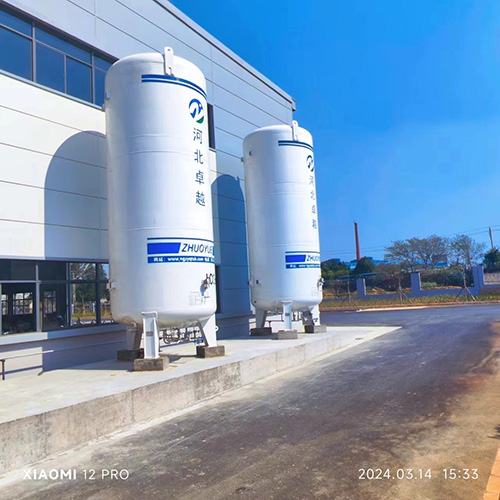
Ⅰ. First, understand a basic fact
Liquid nitrogen is not a rare substance. There is already about 70% nitrogen in the air. When it is pressurized and cooled to around -196°C, it turns into a transparent and colorless liquid. But the problem is that it is very “impatient” – a slight increase in temperature causes it to boil and escape immediately. One liter of liquid nitrogen can expand to nearly 700 liters of gas upon vaporization. Just imagine, if the tank is sealed too tightly without a vent, it would be a time bomb.
So, from the very beginning of its design, the cryogenic tank was not intended to be completely airtight.
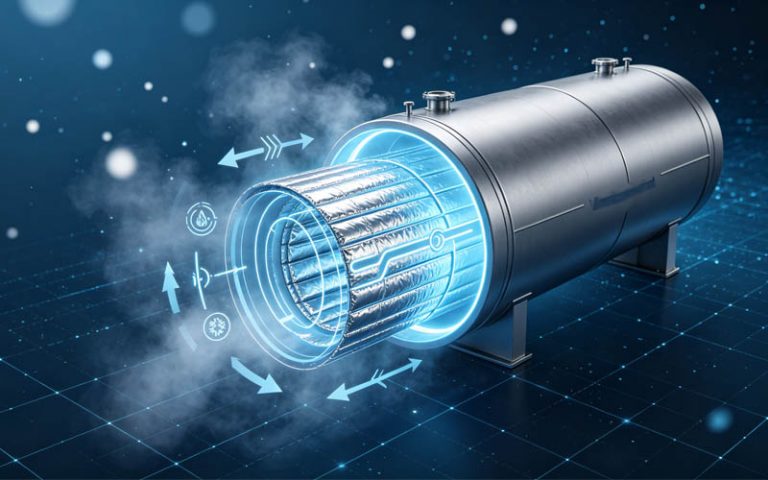
Ⅱ. Double-layered walls and vacuum, simply put, it’s a super insulated bottle
Just like your household water bottle, the principle of the cryogenic tank is the same, but it is even more extreme. The inner container holds the liquid nitrogen, the outer shell blocks external heat radiation, and the middle layer is evacuated to a high vacuum. Heat trying to enter? There’s almost no way.
But to be honest, the vacuum level will gradually decrease over time. So, good tanks will have multiple layers of insulation materials stuffed in the inner layer, along with an absorber to maintain the vacuum level. That’s why some cheaper tanks have an increased evaporation rate after two or three years – it’s not that the tank is leaking, but the vacuum layer has weakened.
There’s a simple way to judge when buying: look at the daily evaporation rate indicator. Small tanks commonly used in laboratories can achieve an evaporation rate of less than 0.3 liters per day for better ones, while the worse ones may exceed one liter. Over the long term, just the loss of liquid nitrogen alone is a considerable expense.
Ⅲ. Liquid phase and gas phase, don’t make the wrong choice
The tank actually has a layered structure. The bottom is liquid nitrogen, with the lowest temperature and the most stable; the upper part is nitrogen vapor, with a slightly higher temperature.
For cell cryopreservation, sperm banks, and other extremely demanding temperature requirements, samples are usually stored in the liquid phase by directly submerging the storage tubes below the liquid surface. But some samples are afraid of being directly soaked in liquid nitrogen – such as certain electronic components or specific reagents. In this case, gas-phase storage is used, with the samples hanging on the upper part of the tank and cooled by the cold vapor.
I’ve seen some customers discover that they were wrong when they bought the gas-phase tank and used it as a liquid-phase tank, resulting in wasted samples. So, before placing an order, you really need to think clearly about what you need: what to store, where to place it, how often to replenish liquid nitrogen, and whether transportation is required. Once you have these things figured out, talk to a reliable supplier for efficiency.
Ⅳ. Several common mistakes to avoid
First, don’t use a regular plastic tube to measure the liquid level in the tank. Liquid nitrogen will climb up the tube and spray you in the face, not a joke. Use a dedicated liquid level gauge or an intelligent tank with an alarm function for safety.
Second, the storage tank must be placed in a well-ventilated area. It’s not because it might explode, but because it will displace the oxygen in the air. When you feel drowsy and slow to react, it’s not because you can’t breathe, but because it’s too late by the time you realize something is wrong. Basement, storage room – these small, enclosed spaces must not be used.
Third, when lifting the tank, don’t just hold the handle. A tank filled with liquid nitrogen is not light; if the handle comes off or the ground is slippery, the entire tank will fall to the ground. You won’t want to experience that scene.
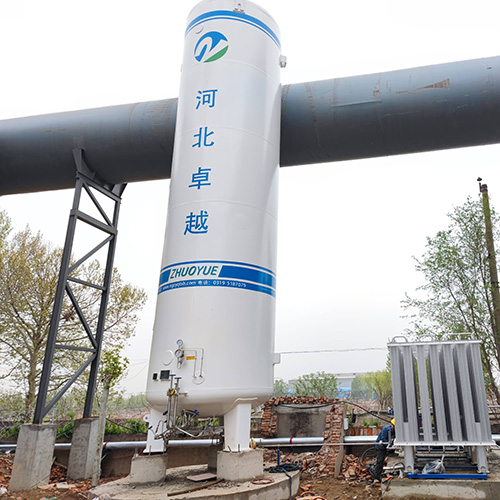
Ⅴ. Choosing a tank, it’s more about the scenario than the parameters
There are tanks available in the market ranging from a few liters to several hundred liters, with materials including stainless steel and aluminum, and the price difference can be several times. My advice is not to just focus on the brand and price. First, clearly understand your usage scenario: what to store, where to place it, how often to replenish liquid nitrogen, and whether transportation is required. Once you have these things figured out, talk to a reliable supplier for efficiency.
The storage of liquid nitrogen is a process with relatively high technical requirements. However, the problems often arise not from the equipment itself, but from the users who do not have sufficient understanding of it. Knowing more reduces the risk.