Global buyers must read this: How to select liquid oxygen, liquid nitrogen, liquid argon, and LNG filling pumps? This practical manual helps you avoid pitfalls.
Many overseas buyers often fall into a misunderstanding when purchasing low-temperature filling equipment – they focus only on the parameter table but ignore the matching of working conditions. Choosing the wrong pump can result in a significant reduction in efficiency or frequent safety hazards. As a manufacturer deeply involved in low-temperature gas equipment, Outstanding today uses an engineer’s perspective to help you thoroughly clarify the selection logic.
Ⅰ. First, understand what you are filling.
Cryogenic filling pumps are not “one pump for all”. Different media require different materials, sealing methods, and pre-treatment requirements. Liquid oxygen media require all contact parts to pass ASTM oxygen compatibility certification, and lubricating grease must be selected as dedicated low-temperature oxygen-compatible grease; liquid nitrogen and liquid argon are relatively tolerant, but still require high-vacuum jacketed pump heads to reduce heat loss; LNG is an explosive and flammable medium, and it is recommended to use submersible non-sealed pumps, with the motor directly immersed in the low-temperature liquid to eliminate leakage risks from the source.
Core reminder: Confirm the medium first, then discuss the model. Many customers mix liquid oxygen pumps and liquid nitrogen pumps, which is strictly prohibited in actual operation.
Ⅱ. Three hard indicators determine the quality of the pump.
Flow and pressure matching. The filling scenario usually requires a flow range of 50 to 3000 L/h, and the outlet pressure ranges from 16.5 MPa to 35 MPa. For large-volume filling of storage tanks, a multi-plunger pump of 10000 L/h level may be required. When selecting, be sure to calculate based on your daily filling volume and reserve 20% margin.
Continuous operation capability. Industrial-grade filling pumps require 24-hour uninterrupted operation, and the packing seal life must reach at least 4000 hours. The pump head adopts a high-vacuum jacketed design, which can effectively block external heat intrusion. If your working condition is three shifts, be sure to confirm that the manufacturer provides a continuous operation test report.
Pre-cooling and anti-air erosion. Before starting the low-temperature pump, it must be fully pre-cooled. The inlet pipe should be as short as possible and have a slope to reduce flow resistance. If the pre-cooling speed is too fast, it will cause pipeline stress; if too slow, it will delay the construction schedule. More importantly, anti-air erosion – if the liquid in the pump is vaporized and blocks the flow path, the metal of the blades will be continuously eroded. The correct approach is: lower the installation height, strengthen the insulation of the pipeline, and avoid long-term idling.
Ⅲ. Zhuoyue selection logic: Don’t sell expensive, only sell the right one.
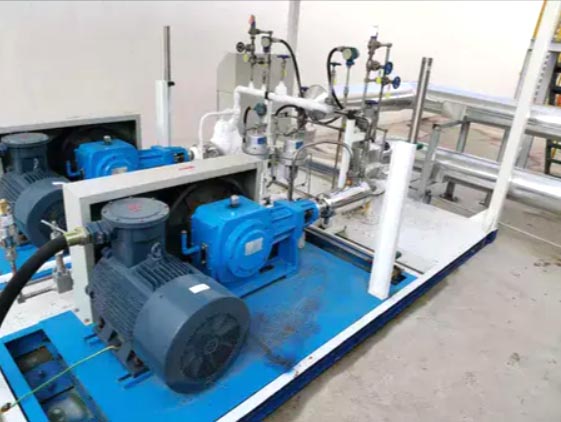
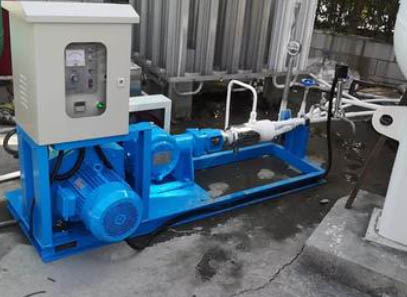
The cryogenic filling bottle pump series covers various specifications, with single-head, double-head, and triple-head configurations available, and a dedicated pump for carbon dioxide is also available online. Each pump is tested for the drive end and integrated assembly before leaving the factory. At the after-sales level, we provide comprehensive quality assurance and remote installation guidance and training by engineers, which is rare in the industry.
In a nutshell: When selecting cryogenic filling pumps, working conditions should be defined first, parameter verification second, and after-sales guarantee is the long-term value.
Have selection confusion? Leave your medium type and daily filling volume, and Zhuoyue technical team will provide a customized solution for you for free.