

CNG Cylinders vs. CNG Cylinder Groups: What’s the Difference?
In the field of compressed natural gas, the correct use of terms is by no means an easy task; it concerns safety and efficiency. Although it is often heard that some people confuse “CNG cylinders” and “CNG cylinder groups”, in engineering design, it is not allowed to mix these two concepts.One is a single component; the other is a complex, interconnected system. Grasping this distinction is vital, whether you are laying out a new refueling station, optimizing a vehicle fleet, or simply sourcing the right high-pressure storage gear.
What is a CNG Cylinder?
A CNG cylinder is the fundamental building block of natural gas storage. It is a single, standalone high-pressure vessel specifically designed to store Compressed Natural Gas (CNG).
These cylinders act as the primary containment for the gas, which is typically compressed to pressures around 20 MPa (200 bar) or 25 MPa (250 bar). CNG cylinders are manufactured from robust materials to withstand immense internal pressure. Common types include:
Type 1: All-metal construction (usually seamless steel or aluminum).
● Type 2 & 3: Metal liners wrapped with composite materials (like fiberglass or carbon fiber) for added strength and reduced weight.
● Type 4: Non-metallic (plastic) liners with full composite wrapping.
You’ll find these cylinders everywhere—from the trunk of a taxi to the roof of a city bus—but at the end of the day, the single cylinder is just the fundamental building block.
What is a CNG Cylinder Group?
Do not view a compressed natural gas cylinder group (commonly referred to as a cylinder bank or bundle) as a simple accumulation of individual components, but rather as a carefully designed integrated structure. It will fix multiple independent cylinders onto the same frame or support.
However, the key lies in how they are connected: a complex system consisting of high-pressure pipes, valves, and safety devices connects all the parts, enabling the entire bank to function as a whole and operate normally.This configuration allows the group to function as a single, unified storage unit with a much larger total volume than a single cylinder could provide.
In CNG filling stations (especially the main stations and pressure regulating stations), the gas cylinder groups serve as buffer storage devices. They can store a large amount of gas transported by pipeline transport vehicles or compressed on-site by compressors, thereby ensuring a stable and large flow of natural gas supply to vehicles and enabling rapid refilling.
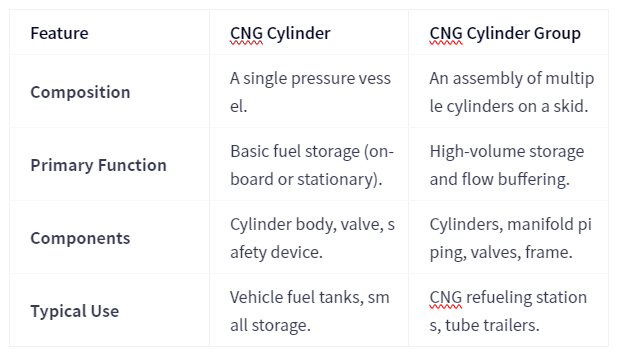
Key Differences at a Glance
To help you choose the right equipment for your project, here is a quick comparison:
Why the Distinction Matters
Whether you use low-temperature equipment or gas equipment, as long as you truly understand these differences when conducting maintenance and safety management, the outcome will be significantly different for you. Your focus will no longer be solely on individual containers. When you use gas cylinder sets, your focus shifts. It’s not just about inspecting a single tank; you have to verify the integrity of the entire manifold and make sure all the interconnected vessels are working in sync.
At Zhuoyue Gas Equipment, we understand the nuances of high-pressure gas storage. Whether you need individual high-performance cylinders or fully assembled cylinder groups for your infrastructure, ensuring your equipment meets international safety standards is our top priority.
Looking for reliable CNG storage solutions? Contact our engineering team today to discuss your specific pressure and volume requirements.