

An ambient air vaporizer can look large enough on a datasheet and still struggle on the coldest morning of the year. That usually happens because someone sized it from average gas consumption, used the annual average air temperature, or compared two capacities stated under different “normal” conditions.
Calculating ambient air vaporizer capacity is not difficult. The important part is knowing which assumptions can quietly make the result wrong.
Start with the gas demand at your facility. Work out how much heat is needed to turn the liquid into gas, then check whether the proposed vaporizer can transfer that heat from the surrounding air at your lowest design temperature. A unit that passes this check on paper still needs a final review of pressure, frost, wind, and piping conditions.
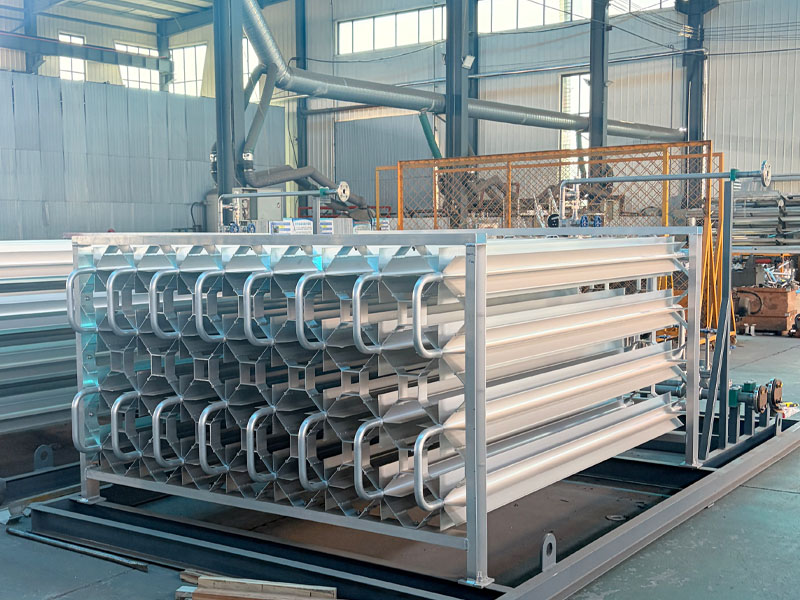
Begin With the Process Duty
Before looking at the number of vaporizer banks or the total fin area, write down the actual operating requirement.
You need the gas type, peak flow rate, minimum ambient temperature, liquid supply pressure, required gas outlet pressure, and desired outlet temperature. Oxygen, nitrogen, argon, and LNG have different densities and vaporization duties, so their capacities cannot be exchanged directly.
Use the highest simultaneous demand. If two production lines can start together, or a peak-load user can overlap normal consumption, that combined flow is the sizing point. Daily consumption is useful for estimating operating cost, but it does not tell you whether the vaporizer will keep up during a peak period.
Also confirm what the supplier means by Nm³/h. Some quotations use a reference temperature of 0°C, while others use 20°C. Reference pressure must be stated as well. Without this information, two suppliers may appear to offer different capacities even when the gas mass flow is similar.
Convert Gas Flow Into Required Heat
Most vaporizer ratings are given in Nm³/h, but heat-transfer equipment is sized from thermal duty. First convert the gas volume into mass flow
ṁ = Vₙ × ρₙ
Here, ṁ is mass flow in kg/h, Vₙ is flow in Nm³/h, and ρₙ is gas density at the same normal conditions.
For example, oxygen has a density of approximately 1.429 kg/Nm³ at 0°C and 1.013 bar. A requirement of 600 Nm³/h therefore gives
600 × 1.429 = 857.4 kg/h
Next, calculate the heat needed to vaporize the liquid and bring the gas to its required outlet condition
Qᵣₑq = ṁ × Δh
Qᵣₑq is heat duty in kW, ṁ is mass flow in kg/s, and Δh is the enthalpy difference between the inlet liquid and outlet gas in kJ/kg.
Using the oxygen example, 857.4 kg/h equals 0.2382 kg/s. If the verified enthalpy difference at the design pressures and outlet temperature is 350 kJ/kg, the required duty is
0.2382 × 350 = 83.4 kW
The 350 kJ/kg figure is illustrative. Actual values depend on gas composition, pressure, inlet condition, and outlet temperature. Use property data or a calculation from the equipment supplier rather than borrowing a value from another gas or application.
Latent heat alone is not always enough. If the process requires gas warmer than the temperature leaving the vaporizer, sensible heating must also be included. A downstream gas heater may handle that duty, but it should not be mistaken for vaporizer capacity.
Check the Heat Available From Ambient Air
The basic relationship for heat transfer from air is
Qₐᵥ = U × A × ΔTₑff
U is the overall heat-transfer coefficient, A is the effective heat-transfer area, and ΔTₑff is the effective temperature difference between the ambient air and the vaporizer surface.
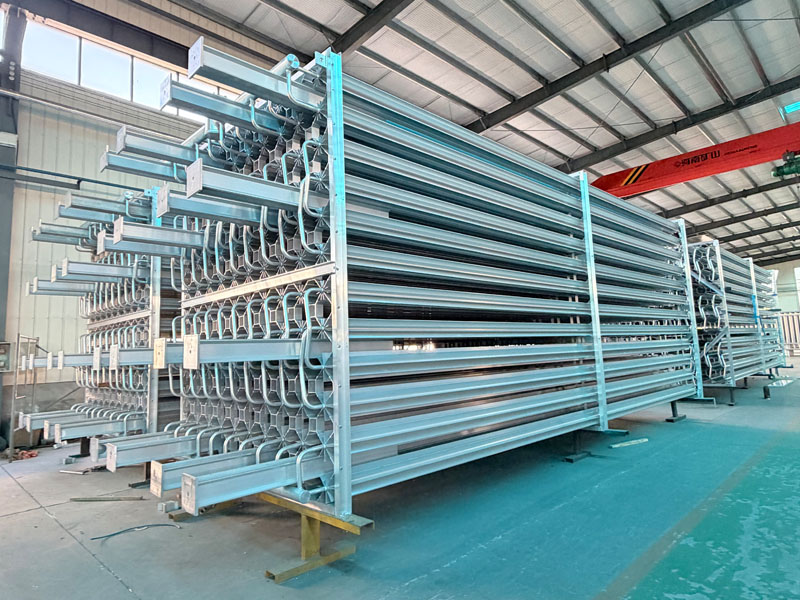
Finned tubes provide more surface area, but not all of that area performs equally. Fin efficiency, airflow, frost, and surface temperature all affect the result. This is why a buyer should not select an ambient vaporizer from fin dimensions alone.
For equipment selection, the more useful figure is the manufacturer’s capacity at your stated conditions. Ask for performance at the minimum site ambient temperature, the actual operating pressure, and the expected duty cycle. The available heat duty must meet or exceed the calculated process duty.
Cold Weather and Frost Deserve Separate Attention
Capacity falls as ambient temperature falls. A lower air temperature leaves less temperature difference to drive heat into the liquid, so the same vaporizer cannot necessarily maintain the same gas output.
A rating published at 20°C is therefore not enough for a cold-climate installation. Request a winter rating based on the lowest temperature that can reasonably occur at the site. Do not use the annual average as a substitute.
Frost creates another limitation. Ice on the fins acts as insulation and can restrict airflow. During prolonged operation, the effective capacity may decline even if the air temperature remains unchanged. Some installations use multiple banks with a defrost arrangement so one section can recover while another remains in service.
When comparing proposals, ask whether the stated capacity is gross or net. Gross capacity may describe the rated output of the complete unit. Net capacity can be lower after allowances for frost, liquid subcooling, pressure losses, and operating margin. If the supplier’s rating already includes an allowance, adding another generic margin may only increase cost without improving reliability.
Confirm the Selection Before Ordering
A good enquiry should include the gas type, peak Nm³/h, minimum ambient temperature, pump or storage-tank pressure, required outlet pressure, operating pattern, site altitude, and available installation area. Include the piping layout if backpressure or elevation differences may affect liquid supply.
Then ask the supplier to confirm four points: the reference conditions used for capacity, the rating at minimum ambient temperature, the allowable operating pressure, and whether the capacity is gross or net.
This check takes little time compared with correcting an undersized system after installation. A vaporizer that meets the calculated duty under realistic site conditions will provide a more stable gas supply than one selected from nominal flow alone.