As a long-term supplier of cryogenic gas equipment serving global energy, manufacturing, and infrastructure projects, we have engaged with numerous industrial buyers. More than 60% of our clients repeatedly ask the same question during their first procurement of high-pressure natural gas storage and transportation equipment: What is the actual difference between a CNG Tube Skid and a CNG Cylinder Bundle? Many people treat these two types of equipment as identical products, using the terms interchangeably in tender documents. This often leads to receiving goods that do not match project requirements, causing schedule delays and incurring extra logistics and modification costs of tens of thousands of euros.
For overseas oil and gas operators, industrial gas enterprises, temporary project contractors, and hydrogen storage and transportation service providers, selecting the right equipment directly determines operating costs, site adaptability, and long-term safety over a period of 3–5 years. This article does not simply copy parameter tables found everywhere online. Instead, drawing on our practical experience from more than 200 implemented projects worldwide, we thoroughly explain the differences between the two across four core dimensions: structural design, application scenarios, compliance requirements, and maintenance costs. Our goal is to help you avoid the most common pitfalls in equipment selection.
I. Fundamental Differences in Core Structure and Design Logic
Product brochures from many suppliers describe both CNG Tube Skids and CNG Cylinder Bundles as “multi-cylinder high-pressure gas integrated systems.” However, their underlying design logic differs fundamentally from the project initiation stage.
A CNG Tube Skid (also known as a CNG Tube Skid System) is designed with the core objectives of modularity, rapid deployment, and adaptability to complex sites. All high-pressure cylinders, piping, valves, safety relief devices, and control instruments are pre-integrated onto a steel base frame compliant with ISO standards. The entire skid can be transported via standard containers. Upon arrival at the project site, no additional fixed supports are required; it only needs to be connected to inlet/outlet pipelines and an external power source to become operational. Common Tube Skids accommodate anywhere from 4 to 16 cylinders, utilizing large-volume seamless high-pressure tubes. Mainstream models feature single cylinder volumes exceeding 2,000 liters. The frames are constructed from high-strength, lightweight steel, and some models exported to Europe and North America use aluminum alloy components for further weight reduction, optimizing overall self-weight while maintaining load-bearing capacity.
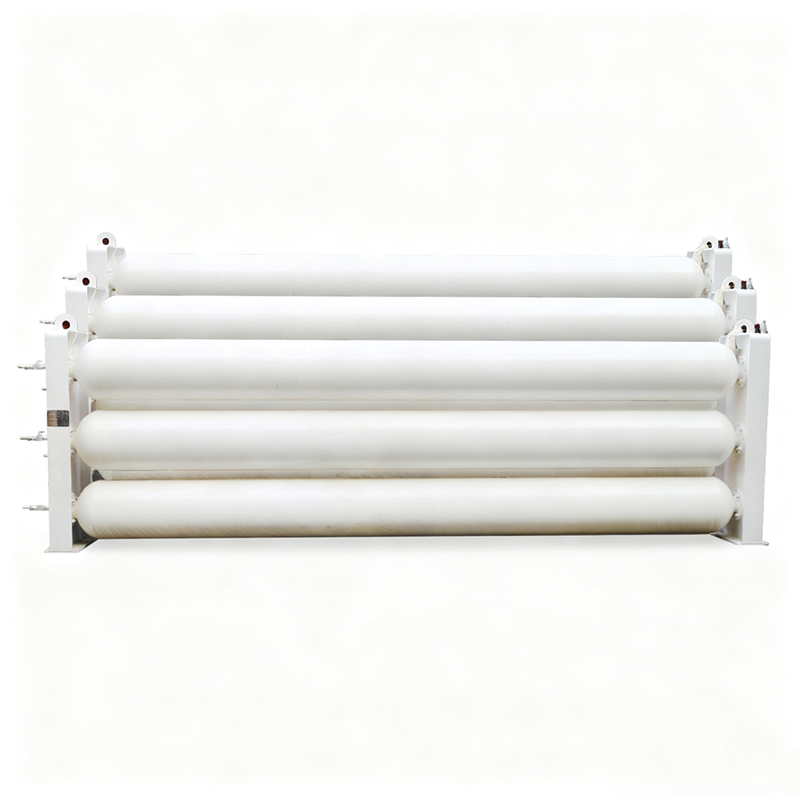
In contrast, a CNG Cylinder Bundle (or CNG Cylinder Bank) is designed with the core objective of maximizing gas storage volume and adapting to long-term fixed station usage. Its structural focus is entirely on integrating the group of high-pressure cylinders. It lacks a fully pre-assembled functional skid base. The cylinders are secured directly to a large chassis or concrete foundation using high-strength steel straps and cross-brackets. Associated pressure regulation, control, and safety accessories are typically installed and commissioned separately on-site. These products usually start with 12 cylinders, with some custom models integrating over 20 large-volume high-pressure steel cylinders. Consequently, they offer significantly higher total gas storage capacity compared to Tube Skids of similar size, making them better suited for fixed gas supply scenarios that do not require frequent relocation.
There are also distinct differences in core materials: To balance lightweight design and weather resistance, mainstream CNG Tube Skids mostly utilize 4142 high-strength alloy steel or Type 3 carbon-fiber-wrapped liners. Some special models adapted for hydrogen storage and transportation use 4130X material. Under a standard working pressure of 25 MPa, this ensures structural strength while keeping the overall self-weight at an optimal level for lifting and transport. Traditional CNG Cylinder Bundles, aiming for ultimate pressure-bearing lifespan, almost exclusively use 4130X/30CrMo seamless steel cylinders. These have thicker walls and a heavier overall structure, providing stronger resistance to external impact when placed in fixed locations for extended periods.
II. Key Differences in Application Scenarios and Adaptability Boundaries
If you ask small-to-medium suppliers about the different usage scenarios for CNG Tube Skids and CNG Cylinder Bundles, they will likely tell you that “both can be used to transport CNG.” However, in actual implementation projects across different industries globally, the adaptability boundaries for each are very clear. Choosing the wrong scenario can lead to a significant drop in operational efficiency.
The core advantage of the CNG Tube Skid is its versatility across all scenarios, serving as the primary carrier for “virtual pipeline” gas supply solutions. The most common application scenarios include:
- Remote mining areas and oilfield operation points where main natural gas pipelines have not yet reached, allowing for the temporary setup of mobile gas supply points without complex civil engineering construction, enabling deployment within days.
- Temporary peak-shaving gas supply units during urban gas pipeline renovations, which can be lifted directly to the site to replace existing pipelines and ensure gas supply for residential and commercial users.
- Cross-regional hydrogen transfer projects, where Tube Skids adapted for specific materials can directly carry hydrogen fuel, fitting into the rapidly expanding hydrogen infrastructure networks in Europe and North America.
- Backup emergency gas sources for large factories, stored in idle areas of the plant and quickly activated when external pipelines fail, ensuring production lines do not halt due to gas interruptions.
Last year, we delivered an 8-tube CNG Tube Skid to a large manufacturing park in Southeast Asia, perfectly meeting local temporary gas supply needs. The entire skid was loaded into a 40-foot standard container and shipped directly from a Chinese port to the park entrance. On-site engineers completed all connections and commissioning in just six hours, delivering gas 14 days earlier than traditional methods and saving the client nearly $1 million in production downtime losses.
The core advantage of the CNG Cylinder Bundle lies in its large storage capacity and long-term stable operation, making it more suitable for large-scale centralized gas supply in fixed scenarios. Typical applications include:
- Fixed storage cylinder banks at large CNG filling stations, serving as the core storage unit to continuously provide refueling services for taxis and logistics vehicles.
- Large peak-shaving reserve facilities at city gate stations, supplementing network pressure during peak usage periods to avoid winter gas shortages.
- Permanent industrial gas supply stations for large steel and chemical enterprises, delivering high-pressure natural gas to production lines 24/7 without requiring frequent equipment movement.
We delivered a 16-tube CNG Cylinder Bundle to a chemical base in Europe, installed on a fixed concrete foundation. It has operated stably for three consecutive years, requiring only routine annual inspections. Its overall gas supply stability is more than 30% higher than that of mobile equipment, fully meeting the strict continuity requirements of chemical production.
In short, if you need equipment that changes sites frequently and deploys quickly, prioritize the CNG Tube Skid. If your equipment will operate long-term at a fixed location, pursuing maximum storage volume and the lowest long-term unit storage cost, the CNG Cylinder Bundle is the more cost-effective choice.
III. Differences in Compliance Certification and Global Market Access
One point most easily overlooked by overseas buyers during selection is that the compliance and market access requirements for these two types of equipment differ completely across different countries and regions. Many customers have faced issues such as inability to clear customs upon arrival or even rejection by local regulatory authorities because they failed to notice this distinction.
As a complete integrated skid system, a CNG Tube Skid requires a comprehensive set of certifications for export to major global markets. For the North American market, it must comply with DOT regulations; for the European Union, it must pass PED (Pressure Equipment Directive) certification; for regions like Southeast Asia and Australia, it needs overall certification from third-party agencies such as ISO and BV. Some countries also require separate compliance reports for the skid’s overall frame, piping systems, and safety components. This means that a qualified CNG Tube Skid completes over 90% of its testing before leaving the factory. Upon arrival, it only requires simple on-site verification before being put into use, eliminating the need for buyers to arrange secondary integration certification with external agencies.
Conversely, as a bulk-integrated cylinder group, the compliance requirements for a CNG Cylinder Bundle focus primarily on the individual cylinders themselves. Each steel cylinder must obtain corresponding pressure vessel certification. However, much of the compliance responsibility for the connecting pipes between cylinders and the fixing brackets falls on the installation party at the project site. While this is not an issue for large energy projects with professional engineering teams, it can easily lead to situations where installations fail to pass acceptance checks by local work safety departments for small-to-medium industrial enterprises lacking special equipment installation qualifications.
We have encountered numerous small-to-medium clients from the Middle East and South America who previously purchased CNG Cylinder Bundles from other suppliers. Upon arrival, they discovered that local regulators required the entire assembly to hold ASME certification, whereas their purchased product only had individual cylinder certifications. They were forced to spend tens of thousands of dollars to engage local agencies for supplementary testing, delaying the project by nearly two months. This is precisely why we now clearly distinguish the compliance requirements for both types of equipment to all clients in advance, helping them avoid pitfalls during customs clearance and acceptance.
IV. Comparison of Lifecycle Maintenance and Costs
Many overseas buyers only compare the purchase price of the equipment during selection, ignoring subsequent maintenance costs over 5–10 years. When calculating the total cost, they often find it far exceeds expectations.
From a procurement cost perspective, a CNG Tube Skid with the same gas storage capacity is 15%–25% more expensive than a CNG Cylinder Bundle. This is because the Tube Skid has already pre-integrated the frame, piping, control instruments, and safety accessories. Multiple pressure tests and leak detection checks are completed before leaving the factory, costs which are reflected in the purchase price. While the unit price of a CNG Cylinder Bundle is lower, it incurs additional expenses for on-site installation, commissioning, and third-party testing. These scattered costs often account for more than 20% of the equipment’s purchase price.
The differences in long-term maintenance costs are even more pronounced. In a CNG Tube Skid, all valves and instruments are concentrated on the skid’s operation panel, making daily leak detection, pressure testing, and component replacement very convenient. Ordinary maintenance personnel can handle most tasks after simple training, resulting in annual maintenance costs of approximately 2%–3% of the equipment’s purchase price. In contrast, the cylinders in a CNG Cylinder Bundle are dispersed and fixed on large brackets, with many pipe interfaces located deep within the equipment. Daily leak detection and maintenance require specialized lifting and testing equipment, demanding higher professional skills from maintenance staff. Consequently, annual maintenance costs typically reach 4%–5% of the purchase price.
Regarding service life: In mobile usage scenarios, the CNG Tube Skid’s overall design accounts for vibration and shock during transport, allowing for stable use for 8–10 years under normal maintenance. If a CNG Cylinder Bundle is moved frequently, it is prone to loose pipe interfaces and bracket deformation, reducing its service life to less than 5 years. In fixed scenarios, the service life of cylinders for both types can reach 15–20 years. However, due to its heavier structure, the CNG Cylinder Bundle generally has a corrosion-resistant lifespan 2–3 years longer than the Tube Skid when exposed to harsh outdoor environments over the long term.
Finally, here is a simple selection summary for all overseas industrial buyers: If you need flexible deployment, rapid commissioning, and multi-site adaptability, the CNG Tube Skid is the most cost-effective choice. If you require long-term fixed gas supply, pursue maximum storage volume, and have a professional engineering and maintenance team, the CNG Cylinder Bundle will help minimize your long-term unit gas storage costs. Zhuoyue Gas Equipment, a manufacturer with nearly 20 years of experience in cryogenic gas equipment, can provide free, customized equipment solutions tailored to your project location, compliance requirements, and usage scenarios, helping you avoid unnecessary expenses and detours.