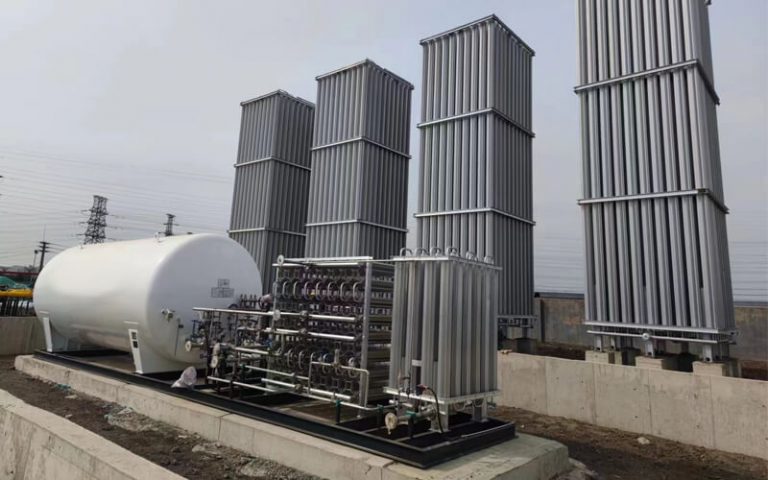


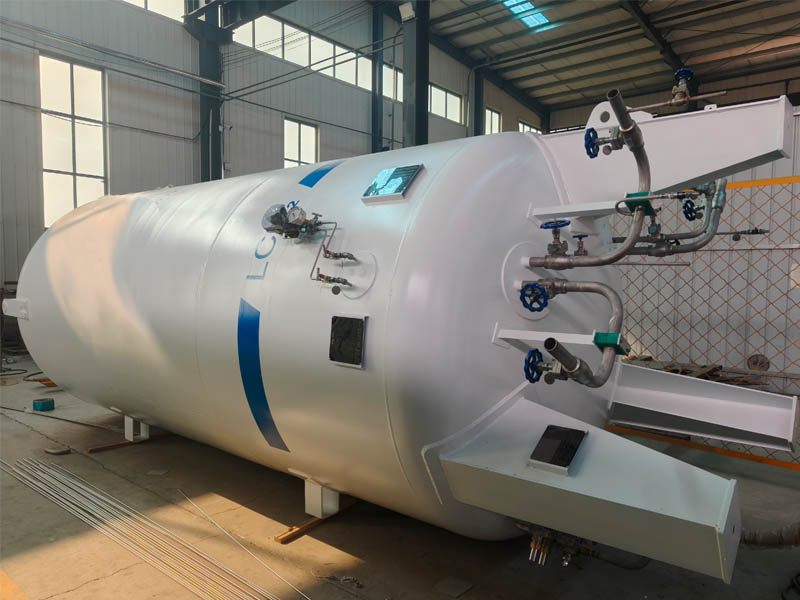
Cryogenic storage tanks play an irreplaceable role in LNG storage and transportation, aerospace propulsion, and industrial gas supply. However, evaporation loss has always been a pain point in the industry – every gram of evaporated liquefied gas means a loss of real money and an increase in safety risks. So, what factors are behind this? The following will be dissected layer by layer from 6 dimensions.
Ⅰ. Ambient Temperature – The Number One “Evaporation Pusher”
Experimental data repeatedly confirm a conclusion: Ambient temperature has the greatest impact on the evaporation rate. The higher the temperature, the greater the temperature difference between the tank wall and the internal liquid, and the heat rushes in like a tide, causing the evaporation rate to soar. For large LNG storage tanks, the pressure increase rate under summer conditions can be several times faster than in winter, and the storage time is significantly shortened. Choosing the right insulation material and optimizing the insulation structure essentially means competing against the ambient temperature.
Ⅱ. Fill Rate – Not Always the More Full, the Less Evaporation
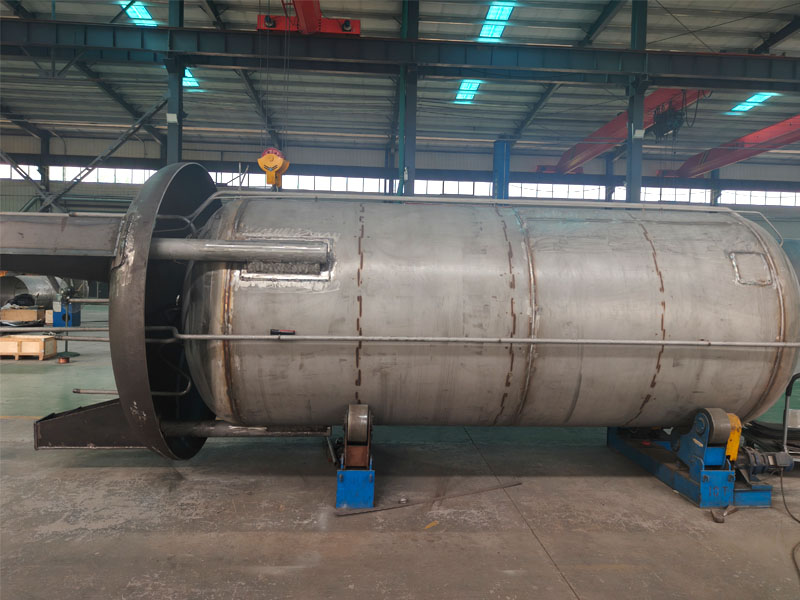
Many people intuitively believe that the fuller it is, the less evaporation there will be. But the truth is far from that. Research has found that there is an optimal fill rate for cryogenic storage tanks, approximately between 0.8 and 0.81. Below this value, the evaporation rate decreases significantly as the fill rate increases; once it exceeds this value, the small gas phase space leads to an increase in evaporation rate instead of a decrease. When the initial fill rate approaches 92.7%, the tank may even enter a negative pressure state, endangering storage safety.
Ⅲ. Internal Pressure – The Key to Dynamic Game
Pressure changes directly rewrite the boiling point of the liquid. The pressure increase stage is divided into three intervals: primary, stable, and rapid. The longer the stable stage lasts, the smaller the pressure increase amplitude, and the lower the evaporation loss. It is worth noting that when the pressure in the gas phase space drops suddenly, the liquid temperature will significantly decrease – this reminds operators: Maintaining the pressure in the stable range is the core strategy for extending safe storage time.
Ⅳ. Type of Boosting Gas – An Ignored Variable
Take liquid nitrogen storage tanks as an example. The effects of using helium gas pre-boosting and nitrogen gas pre-boosting are completely different. Helium gas has a low density and floats on the upper layer of the gas phase, weakening the natural convection driven by buoyancy, resulting in enhanced radial vapor flow and increased wall heat flux density, and the evaporation rate is significantly higher than nitrogen gas pre-boosting conditions. This detail is particularly crucial for the cryogenic fuel management of aerospace propulsion systems.
Ⅴ. Liquid Phase Stratification and Thermal Convection – Invisible Internal Battlefield
Low-density liquids float upward under the effect of buoyancy, while high-density liquids sink to the bottom, forming a stratified structure. This stratification will give rise to thermal capillary convection (Marangoni effect), whose intensity is measured by the Marangoni number. Research shows that a larger Ma value can reduce the surface vapor heat flow by approximately 5%. And under high fill rate conditions, surface evaporation can even reduce by 42% – provided that the tank height-to-diameter ratio is appropriately matched.
Ⅵ. Filling Speed – The Art of Balance between Fast and Slow
There is a rapid temperature drop area when filling cryogenic liquids. The temperature drops sharply, although the time is short, it can trigger material strain. If the speed is too fast, the tank is subjected to thermal shock; if the speed is too slow, the operation cycle is prolonged, and the total amount of environmental heat leakage increases. Finding the “just right” rhythm is a compulsory course for every operator.
Conclusion
The evaporation rate of cryogenic storage tanks is never a game of a single variable, but a dynamic confrontation of six forces: temperature, pressure, fill rate, gas composition, internal convection, and filling process. Only through systematic understanding and precise regulation can each drop of cyogenic liquid be “locked” in the tank. For enterprises pursuing ultimate storage and transportation efficiency, this is not only a technical proposition but also a watershed for business competitiveness.