

In the field of low-temperature gas equipment, micro bulk tanks, with their flexible and compact features, have become an ideal storage solution for laboratories, small manufacturing workshops, and medical clinics, etc. The size, as one of its core parameters, directly determines the adaptability, storage capacity, and ease of use of the equipment. This article will deeply analyze the common size specifications of micro bulk tanks and how to make precise choices based on actual needs.
1.The standard size range of the micro bulk containers
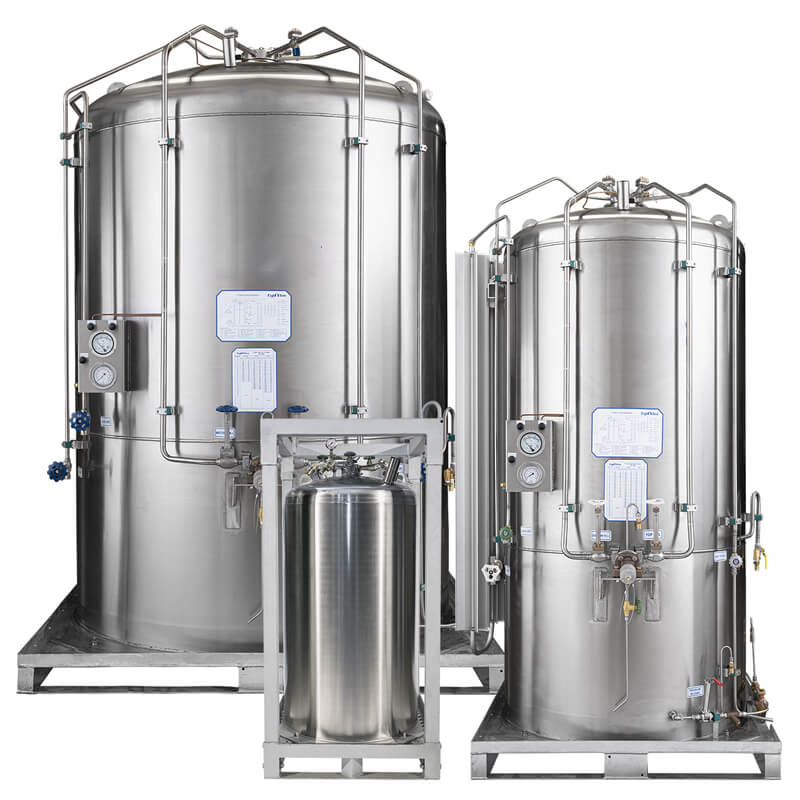
The dimensions of micro bulk containers are typically measured by volume, diameter and height. The common specifications in the industry mainly fall within the following range:
Volume dimension: The volume of mainstream products typically ranges from 50L to 500L. The 50L mini tank is like a small upright refrigerator, suitable for the low-temperature storage of a small amount of samples in the laboratory; the 200L specification can meet the daily gas consumption needs of a small manufacturing workshop; while the 500L large-capacity mini tank can serve as a backup storage device for medium-sized enterprises, balancing storage costs and usage efficiency.
Physical dimensions: The diameter is usually between 600mm and 1200mm, and the height ranges from 1200mm to 2200mm. For example, a 100L mini tank has a diameter of approximately 700mm and a height of about 1500mm, which can easily pass through standard porches and is suitable for most indoor spaces; while the 300L product has a diameter of up to 1000mm and a height of approximately 2000mm, requiring a larger placement area.
II. Customized Sizes: Meeting Special Scenarios’ Requirements
In addition to the standard sizes, many manufacturers of low-temperature gas equipment also offer customized services, adjusting the size of the micro bulk tanks according to specific scenarios:
Narrow space adaptation: In some old laboratories or compact medical consultation rooms, narrow passageways with a width of less than 800mm are common problems. Customized miniature tanks can reduce the diameter to 550mm and keep the height below 1800mm. At the same time, by optimizing the internal structure, they ensure an effective volume of more than 100L.
Vehicle-mounted mobile demand: For outdoor operation scenarios that require on-site gas supply, manufacturers can introduce mini tanks that are compatible with truck cargo compartments. The length should be within 2000mm and the height should not exceed 1800mm. Combined with dedicated fixing brackets, they can achieve safe and stable mobile storage.
III. Core Considerations for Dimension Selection
When choosing the size of the mini bulk containers, one should not only consider the volume, but also take into account the following key factors:
Usage scenario space: Measure the length, width and height of the placement area in advance to ensure that the tank body and the surrounding environment are reserved at least 300mm of operation space, which is convenient for later maintenance and valve operation. For example, in a basement with a height of 2500mm, it is not advisable to choose a tank with a height exceeding 2200mm.
Gas consumption rate: Calculate the daily or weekly gas usage. Select a tank with a volume slightly higher than 1.5 times the average consumption. This approach avoids the inconvenience of frequent refilling while also not increasing safety risks due to excessive storage.
Transportation and installation conditions: If it is necessary to transport using an elevator, it is necessary to confirm the elevator car size and load limit. Generally speaking, for tanks with a diameter of less than 800mm and a height of less than 1800mm, they can be compatible with most commercial elevators.
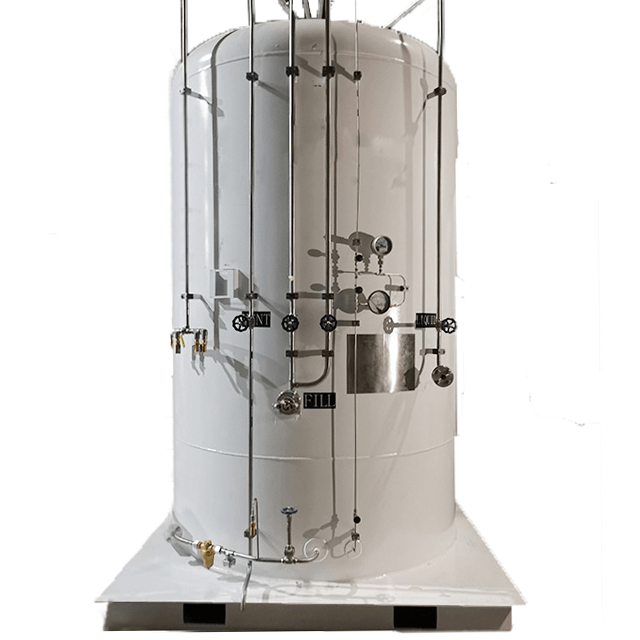
IV. The Balance Between Size and Performance
The size of the micro bulk containers is not necessarily the larger the better, nor is it the smaller the better for flexibility. Instead, a balance needs to be struck among various performance aspects:
Storage efficiency: Under the same volume, a tank with a smaller diameter and a higher height can make better use of the vertical space, but it may increase the difficulty of top operations; while a short and stout tank is more convenient for daily inspection and maintenance.
Insulation performance: The wall thickness of the tank is closely related to its size. Generally speaking, for tanks with larger volumes, the thickness of the insulation layer can be appropriately increased, thereby extending the storage time of low-temperature gases and reducing the loss of volatile substances.
Cost control: Customized-sized tanks usually require additional design and manufacturing costs. If the standard size can meet the requirements, choosing standard products can effectively reduce procurement and maintenance costs.
So, when you’re picking the size for your micro bulk containers, you really need to think about what you’ll actually use them for. Pick the one that works best for your specific situation. If you have any questions before you decide, you can talk to the engineers at Zhuoyue Gas Equipment Co., Ltd. They can help you figure out the best size and make sure everything goes smoothly for storing and using your cryogenic gases.