

A Brief Analysis of the Core Differences between LPG and LNG
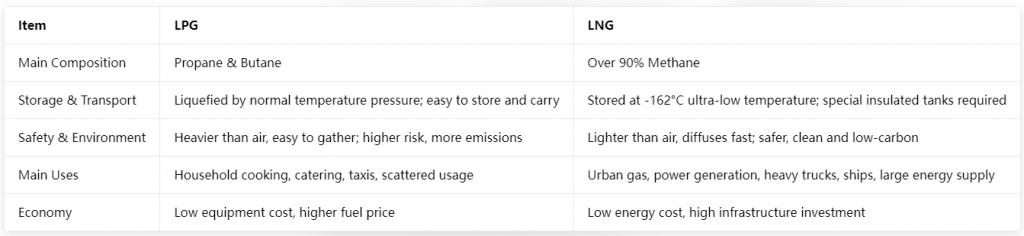
LPG (liquefied petroleum gas) and LNG (liquefied natural gas) are two of the main fuels used in low-temperature gas applications. There are significant differences in composition, storage and transportation, safety, application, and economics.
1.Different sources of components
LPG mainly consists of propane (C₃H₈) and butane (C₄H₁₀), derived from petroleum refining and natural gas extraction. Ethyl mercaptan is often added for leak detection. LNG is mainly composed of methane (CH₄) (>90%), sourced from natural gas fields. It is purified and liquefied at -162°C for deep cold processing, resulting in high cleanliness.
2.Differences in storage and transportation conditions
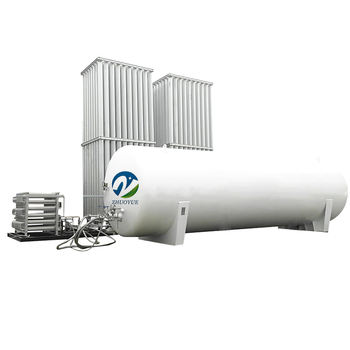
LPG can be pressurized and liquefied at room temperature (1.75–2.0 MPa), and can be stored in spherical tanks, horizontal tanks or portable steel cylinders. It is transportable flexibly and is suitable for areas not covered by pipelines. LNG needs to be stored at -162°C under normal pressure and relies on 9% nickel steel or vacuum insulated tanks. Transportation is by dedicated cryogenic ships or tankers, making long-distance pipeline transportation difficult. It needs to be re-gasified at the terminal before distribution.
3.Comparison of Safety and Environmental Performance
LPG is heavier than air and is prone to accumulate in case of leakage. Its explosion limit is wide (1%–15%), and its ignition temperature is low (approximately 460°C), making it more risky. However, it can be identified by its odor. LNG is gaseous and lighter than air, and leakage is prone to spread. Its ignition temperature is high (approximately 650°C), and its explosion limit is narrow (5%–15%), making it safer. Moreover, it burns cleanly with almost no SOₓ and particulate emissions, and has lower carbon emissions.
4.The application scenarios are clearly differentiated
LPG is highly portable and is widely used in various scattered scenarios such as household cooking, commercial heating, taxi services, and agricultural heating. LNG is suitable for large-scale energy supply, including urban gas, power generation, heavy truck and ship fuel, helping to achieve the carbon reduction goals.
5.Economic trade-off
The unit energy cost of LNG is low, but the infrastructure investment is high; the equipment cost of LPG is low, but the fuel price is higher. Global trends indicate that the demand for LNG is growing faster, but LPG still has an irreplaceable role in areas without pipeline networks.
Conclusion
LPG has flexibility, while LNG excels in terms of cleanliness and scale efficiency. Enterprises should precisely match solutions according to customer needs, promoting the efficient, safe and green application of energy.