

Liquid Nitrogen Tanks: How Do They Work?
How does liquid nitrogen ensure safety during storage? LN2 tanks, also called cryogenic dewars, are pretty cool pieces of tech that keep this super-cold stuff liquid for weeks, or even months. So, what’s the secret? Let’s take a look at how they work without getting too technical.
Why Bother with Special Storage?
Liquid nitrogen is just nitrogen gas (the stuff that makes up most of the air we breathe) cooled down a whole lot. To turn it into a liquid, you have to get it super cold and squeeze it. The problem is, it wants to turn back into a gas. At room temperature, liquid nitrogen will rapidly evaporate, losing approximately 1% to 3% each day. If it is placed in an ordinary container, it will simply vanish with a “pop” sound!Plus, all that gas building up could make things explode. Not good!
Liquid nitrogen tanks solve this by keeping the heat out (to slow down the boiling) and keeping the pressure under control (so nothing blows up).
Maintain low temperature
1.Vacuum Insulation: The Ultimate Heat Shield
Heat moves in a few ways: direct touch, airflow, and heat waves. The LN2 type storage tank adopts a double-layer wall design, which perfectly resolves this issue:
- Inner Shell: Holds the liquid nitrogen. Made of stuff like stainless steel that can handle the cold.
- Outer Shell: Protects the inner shell and keeps the vacuum working.
- Vacuum Space: The area between the shells is almost empty. No air means no heat transfer from touch or airflow. Just a tiny bit of heat gets through from heat waves, which means things stay cold much longer.
To block even more heat waves, the inner shell often has a shiny coating (like aluminum). It bounces the heat back out.
2. Pressure relief: Release pressure
Even with insulation measures in place, a small amount of heat will still seep in, and some liquid nitrogen will also evaporate. When the liquid nitrogen turns into gas, its volume will expand significantly. One liter of liquid nitrogen will turn into nearly 700 liters of gas! If that pressure can’t escape, the tank will burst.
LN2 tanks use safety valves to deal with this:
- A valve (or a rupture disc for emergencies) sits on top of the tank.
- When the pressure gets too high, the valve opens a little and lets some gas out.
- Once the pressure is back to normal, the valve shuts. You might hear a quiet hiss if the tank is warm, but that’s it.
Tank Parts: A Quick Tour
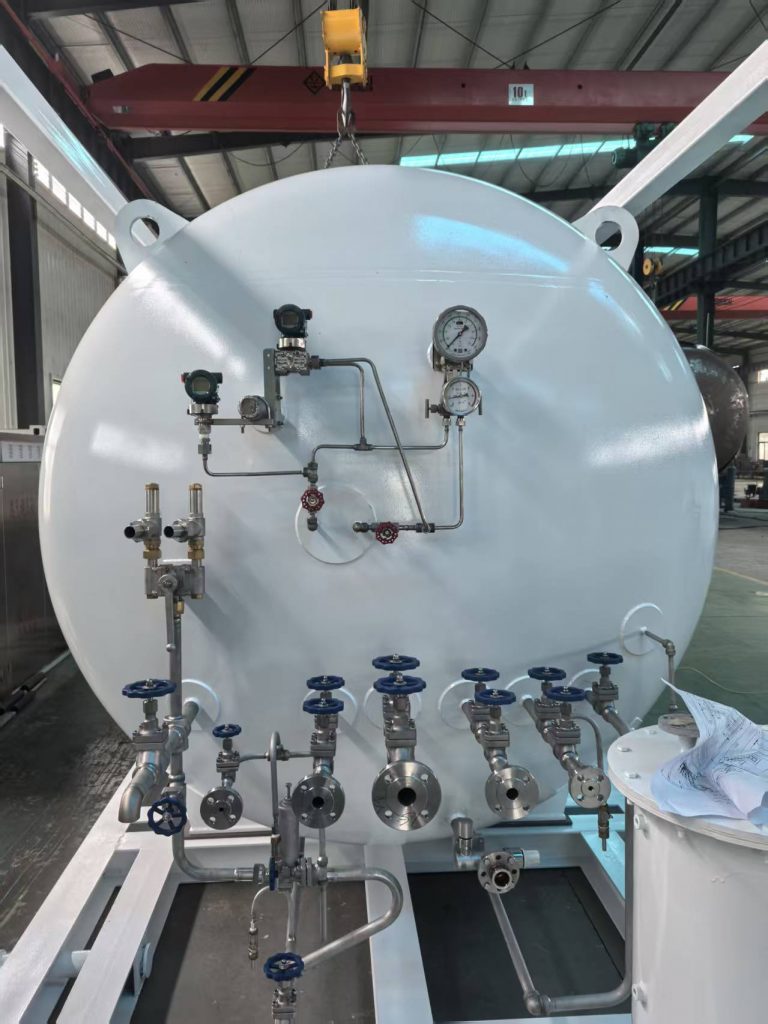
Here are the important parts of an LN2 tank:
- Inner Vessel: Holds the LN2 and can handle rapid temperature changes.
- Outer Vessel: Supports everything and keeps the vacuum sealed.
- Vacuum Port: Where they suck all the air out during making it.
- Pressure Relief Valve: The most crucial safety thing. Stops too much pressure.
- Fill Port: Where you pour in the LN2.
- Discharge Valve: Lets you pour out small amounts of LN2 without full opening the tank.
- Handle/Wheels: So you can move it around.
- Level Gauge: Shows how much LN2 is left.
The above is an introduction to the working principle of the liquid nitrogen storage tank. As a professional manufacturer of cryogenic storage tanks, Zhuoyue Gas Equipment can customize various cryogenic storage tanks according to your needs. If you have any such requirements, you can contact us through the website.