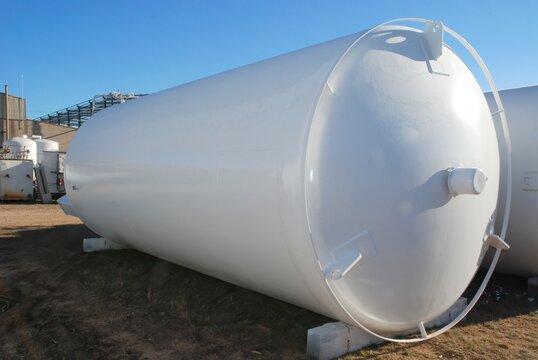


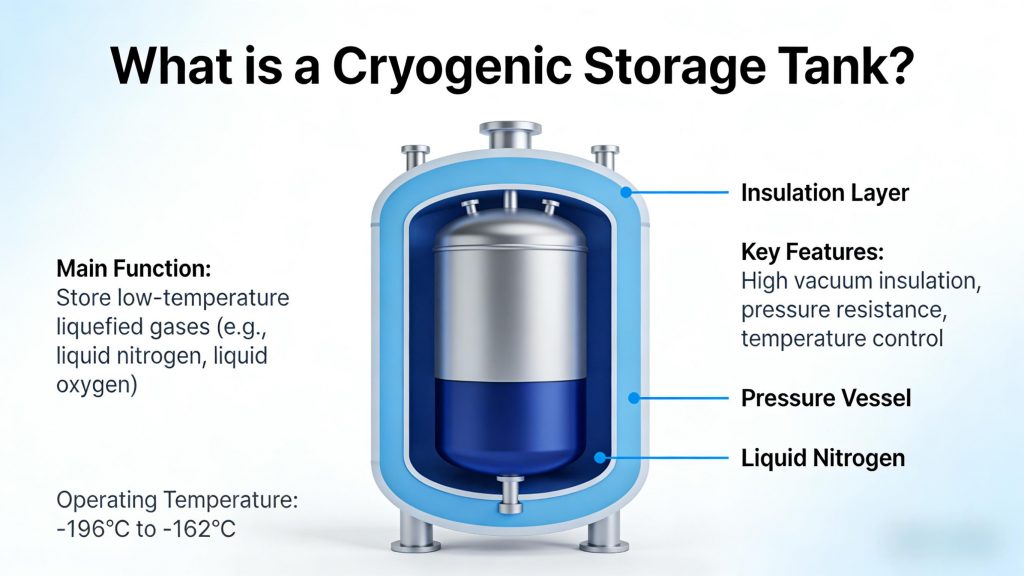
A cryogenic storage tank is a container specifically designed for storing and transporting liquid gases at extremely low temperatures . These tanks are designed in a horizontal orientation to maximize space utilization, making them ideal for locations with limited space, such as industrial facilities, hospitals, and laboratories. Cryogenic storage tanks usually feature compact structural designs to facilitate installation and use in limited spaces, ensuring both safety and operational convenience.
How Cryogenic Storage Tanks Work
Cryogenic storage tanks operate by maintaining a stable, ultra-low temperature environment for liquefied gases. They are constructed with advanced vacuum insulation and a double-wall design to minimize heat transfer, ensuring that the cryogenic conditions are sustained for extended periods. In practical applications, certain scenarios may require the addition of insulation covers. For instance, in the storage of helium and hydrogen, nitrogen-cooled insulation covers are used to reduce the intrusion of heat.The tanks are equipped with provisions for cooling, heating, and venting to manage temperature and pressure fluctuations effectively.
What types of low-temperature storage tanks are there?
Depending on different usage scenarios, low-temperature gas storage tanks can be classified as:
Cryogenic liquid nitrogen storage tanks: These storage tanks are mainly used in industrial and medical fields, and are employed for various operations that require extremely low temperatures.
Liquid Hydrogen Tanks: Engineered to handle the unique challenges of storing liquid hydrogen, which requires temperatures close to 20 K to prevent evaporation and pressure build-up. These tanks are crucial for applications in space exploration and clean energy systems.
Liquid Oxygen Tanks: Used for storing liquid oxygen, these tanks are essential in medical emergencies and industrial processes where a reliable supply of oxygen is critical.
Applications of Cryogenic Storage Tanks
Cryogenic storage tanks have a wide range of applications across various industries:
- Industrial Projects: In industrial settings, these tanks are used for storing liquefied gases such as nitrogen, argon, and carbon dioxide, which are essential for processes like welding, cutting, and refrigeration.
- Medical Facilities: Hospitals and laboratories rely on cryogenic tanks to store gases like oxygen and nitrogen for medical treatments and research purposes.
- Space Exploration: NASA and other space agencies use cryogenic storage tanks to store liquid hydrogen and oxygen for rocket propellants, enabling long-duration space missions.
- Clean Energy Systems: In the transition to clean energy, cryogenic tanks are used to store hydrogen for fuel cell vehicles and other applications, supporting the decarbonization of transportation and industry.
Features and Advantages
The cryogenic storage tanks demonstrate many advantages in practical applications, making them indispensable in both industrial and scientific fields:
Cryogenic tanks can hold a lot for their size, which makes them a good solution whether you’re operating something big or small.
These tanks are thermally sound. The insulation and cooling systems keep heat out, so the gases inside stay cold longer.
These tanks are built to be safe, with features like pressure relief valves and tough construction so you can handle and store gases without worry.
By letting you fill tanks onsite and cut down on moving cylinders around, cryogenic tanks can save industries cash.
It’s not all perfect, though. Liquefying stuff takes a lot of energy, and keeping heat out during storage and transport can be tricky. People are trying to fix these problems by coming up with new materials and designs. For example, composite cryogenic tanks could cut weight. Also, novel thermal network models help control temperatures in liquid hydrogen storage.
Conclusion
Cryogenic storage tanks are a cornerstone of modern industrial and scientific operations, enabling the safe and efficient storage of liquefied gases at extreme temperatures. Their applications span across industries, from medical facilities to space exploration, and their benefits include high storage capacity, thermal efficiency, and cost savings. As technology continues to evolve, cryogenic storage tanks will play an increasingly important role in the transition to clean energy and the advancement of scientific research. Understanding their design, operation, and applications is essential for anyone involved in industries that rely on these specialized vessels.