

Running out of indoor space is a common headache for facility managers. If your company is using carbon dioxide storage tanks, you might consider whether it is possible to store them outdoors.But is it safe?
The short answer is yes, you can store CO2 tanks outside, but you cannot simply leave them exposed to the elements. Because carbon dioxide is sensitive to temperature changes, if you store the carbon dioxide storage tank outdoors, you should have knowledge of safe storage procedures.
Here is what you need to know to keep your operations safe and compliant.
The Physics: Why Temperature Matters
Compared to other gases used in the industry, carbon dioxide is a substance whose properties are the most vulnerable to the influence of temperature. Before being liquefied, the gas is compressed and stored in the tank under high pressure. As a result, one can say that the tank contains a liquid. When the sun heats the gas tank, the liquid inside it expands, causing a rise in pressure. If the tank is filled beyond the specified volume or the temperature is too high, the pressure relief valve might open spontaneously in order to avoid a rupture. Besides being a safety risk, this valve opening also results in product waste.
Conversely, in freezing winter months, your regulators and valves can ice up, causing flow issues. Outdoor storage requires a strategy for both extremes.
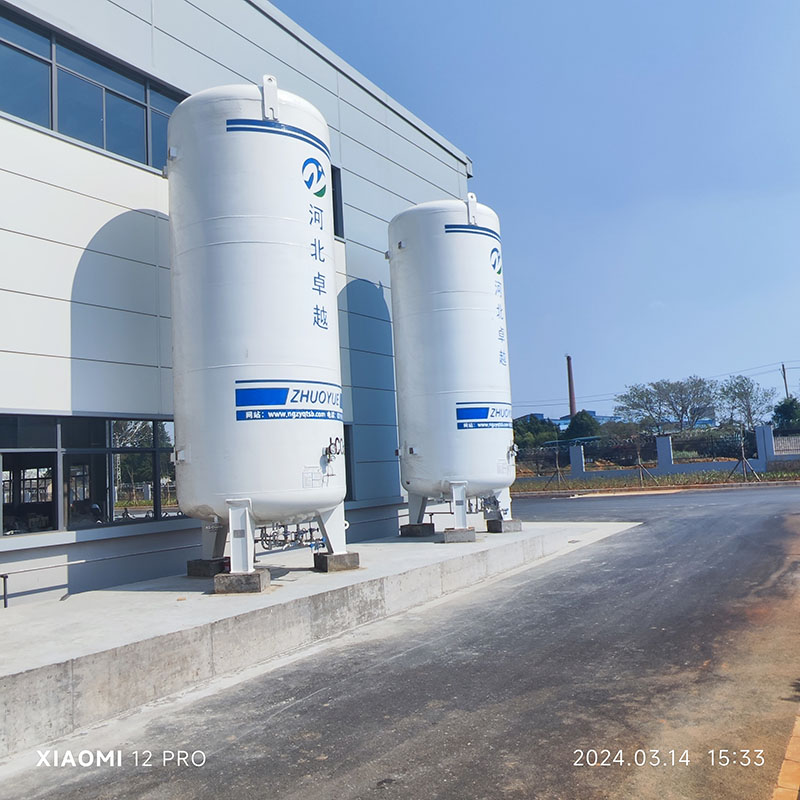
To pass safety inspections and protect your equipment, follow these four guidelines:
To pass safety inspections and protect your equipment, follow these four guidelines:
1. Temperature Control Is a Must
Don’t expose your tanks to direct sunlight. A black cylinder sitting in the sun can heat up on the surface to a temperature that is much higher than the ambient air temperature. Tanks should be stored in a shaded place or a gas cage with a roof should be used. In the case of bulk cryogenic tanks, check if the insulation is still there in order to avoid excessive evaporation (venting).
2.Security and Physical Protection
A full or empty tank of carbon dioxide is very dangerous if it is not properly secured. It should always be assumed that:
- Outdoor tanks can be chained or strapped to a stable structure or placed within a locked gas cage.
- They should be protected from vehicle impacts (for example, forklifts or trucks).
- They must always be kept upright to avoid any liquid CO2 escaping through the valve.
3.Ventilation and Risks of Leaks
Carbon dioxide weighs more than air. Consequently, in case of a leak in a low-lying, unventilated area such as an outdoor corner or a pit, the gas will accumulate at ground level and push out oxygen. This will lead to the formation of an invisible “pool” of gas, which can cause suffocation. Make sure that your outdoor storage is situated on ground-level, is well-ventilated, and is far from building air intakes or basement windows.
4.Corrosion Management
Valves left open to rain or snow, with unevenly piled up ground, or placed in damp environments are the major factors that may cause serious damages to the sealing effectiveness of valves.
If a metal and a valve’s threads are left untreated in a humid environment for painting for a long time, they will eventually be corroded. Just adding a cover or a protective shield could protect the equipment over a long period of time and also increase its service life.
Summary Checklist
Before moving your tanks outside, do a quick check:
Is there a roof or shade structure?
Are the tanks secured against tipping?
Is the area free of depressions where gas could pool?
Is the area secure from unauthorized personnel?
Need Reliable Gas Equipment?
Proper storage starts with quality hardware. Whether you need durable cryogenic tanks or high-quality regulators that can withstand outdoor conditions, we are here to help.
Contact us today to discuss your gas storage setup and ensure your facility remains safe and efficient.