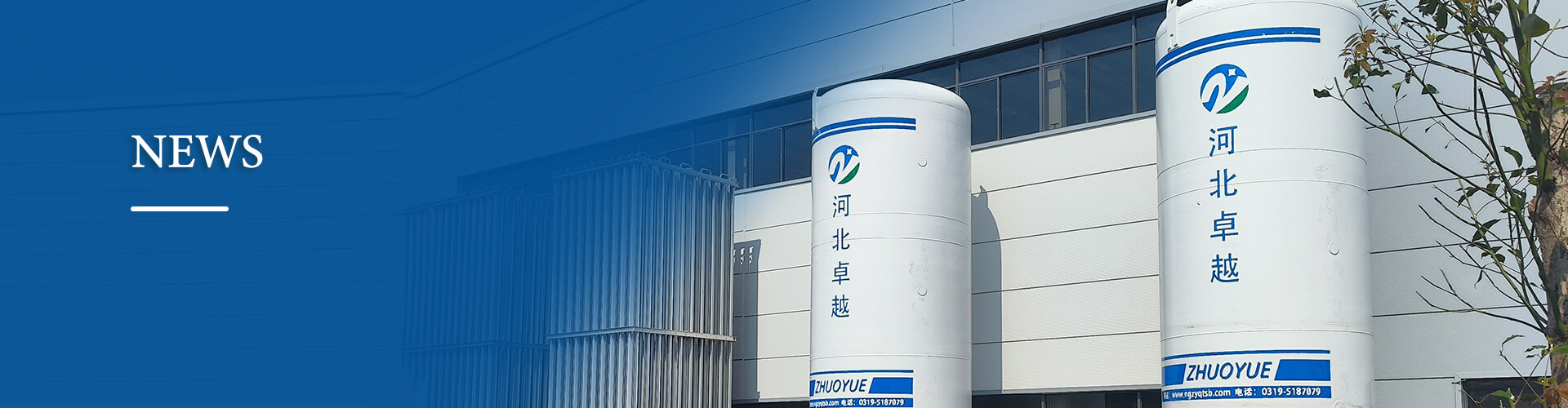
Liquid oxygen, as a strong oxidant, its storage safety is directly related to the stability of industrial production and medical applications. This article systematically expounds the three core prevention technologies of liquid oxygen storage tanks, and provides professional solutions for safety control in high-risk environments by combining engineering practice and industry standards.
1.Stainless steel casing: Building the first line of safety
The application of stainless steel in liquid oxygen storage tanks reflects the deep integration of materials science and safety engineering. Compared with traditional carbon steel, 304/316L stainless steel enhances safety through the following mechanisms:
- Corrosion resistance enhancement: The chromium element forms a dense oxide film, effectively resisting the oxidation corrosion of liquid oxygen
- Low-temperature toughness guarantee: It still maintains good ductility at -196℃ working conditions, avoiding brittle fracture
- Fire resistance performance optimization: The surface oxide layer forms a protective layer at high temperatures, delaying structural failure
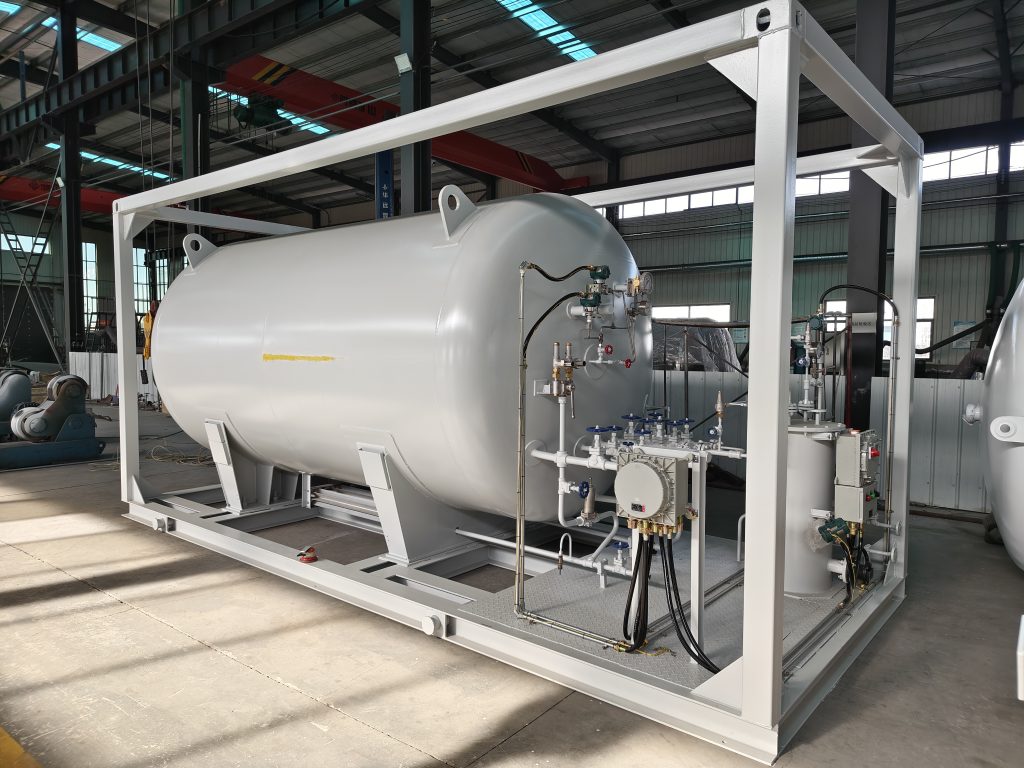
Ii. Airtight Cold Box System: Leakage Control and Risk Isolation
The integrated cold box design achieves multiple protections through three-dimensional space sealing:
- Physical isolation layer: Double-layer stainless steel plates with expanded perlite filled in between, with a thermal conductivity of ≤0.023W/m·K
- Negative pressure control system: Equipped with a micro-positive pressure monitoring device, it will automatically trigger an alarm when the leakage exceeds 0.5L/min
- Gas collection device: A deflector groove is set at the bottom to guide the leaked liquid oxygen into the vaporizer for safe treatment
Iii. Integrated Gas Supply Unit: Systematic Safety Control
The modular gas supply unit achieves intrinsic safety through topological optimization
- Functional integration: Integrate 12 functional modules such as storage tanks, vaporizers, and pressure regulating valves into a standard unit
- Intelligent monitoring: Equipped with a DCS control system, it can monitor 18 parameters in real time, including pressure and temperature
- Emergency linkage: The response time of the leakage detection and automatic shut-off system is ≤0.3 seconds
Industry development trends
Through a three-dimensional protection system of material innovation, system integration and intelligent monitoring, modern liquid oxygen storage tanks have achieved a technological leap from passive protection to active prevention, providing a reliable solution for the storage of high-risk media.